
Trading Against the Higher Timeframe Trend: Why It's Costing You Money
Introduction: You Weren't Fading the Trend. You Were Fading a Pullback.
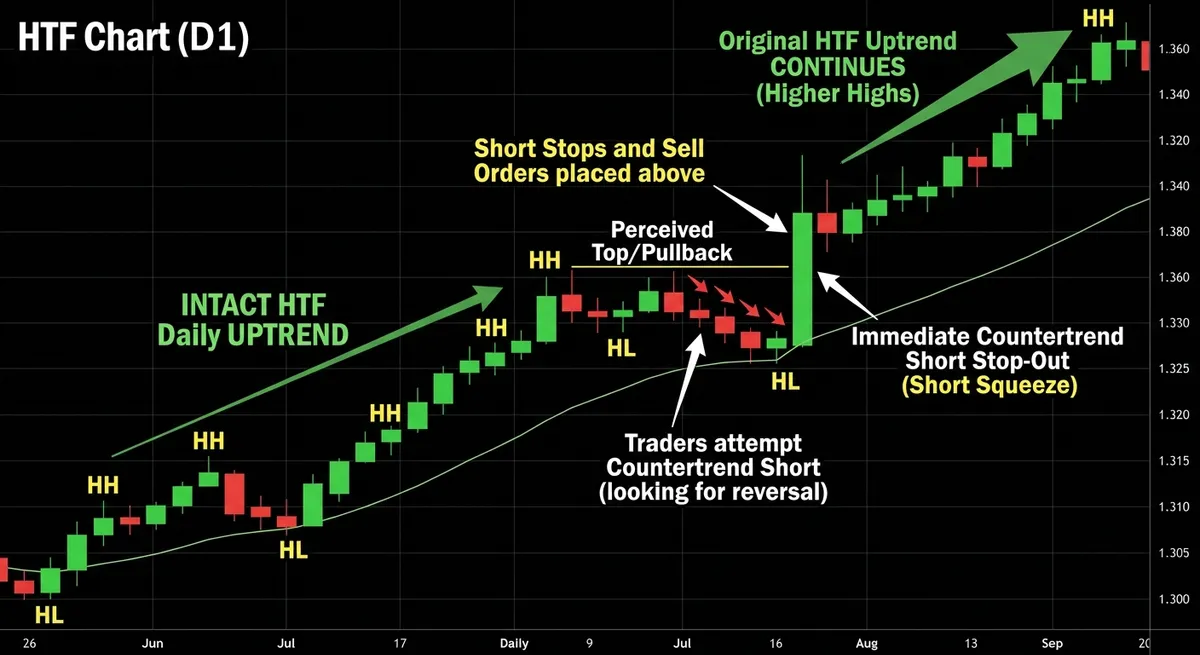
You short a confirmed higher-timeframe uptrend because the lower timeframe just printed a clean bearish Change of Character, and it looks exactly like the start of a reversal. The trade gets stopped out almost immediately, the uptrend resumes, and you're left having paid for a "top" that never actually formed. This isn't a one-time bad read — for most traders taking this kind of setup, it's a repeatable pattern with a structural reason behind it.
Trading against the higher-timeframe trend isn't inherently a mistake. Genuine reversals happen, and catching one early is legitimately valuable. The mistake is treating a lower-timeframe signal — the same kind of signal covered as ordinary correction behavior in the multi-timeframe contradiction post — as sufficient evidence of a reversal on its own. This post breaks down exactly why that substitution costs money, and what actually separates a real countertrend opportunity from a mistimed bet against dominant structure.
The Core Logic: Why Countertrend Entries Carry Structurally Worse Odds
What "Trading Against the Higher Timeframe" Actually Means
A countertrend trade, precisely defined, is a position taken in the opposite direction of confirmed higher-timeframe structure — for example, shorting while the 4-hour chart remains in an intact bullish structure with no confirmed CHoCH of its own. This is distinct from taking a short on the 4-hour chart itself after that structure has genuinely broken. The mistake being addressed here isn't reversal trading in general — it's using a lower-timeframe signal alone to justify a position that fights structure the higher timeframe hasn't actually confirmed has changed.
Why the Win Rate Is Structurally Lower
Higher-timeframe trend structure reflects a larger sample of sustained participation than any single lower-timeframe signal. A confirmed 4-hour uptrend represents accumulated buying interest across many sessions; a 15-minute bearish CHoCH represents a much smaller, more recent, and more easily reversed shift in short-term order flow. Betting against the larger, more established interest on the strength of the smaller, more recent one is, by construction, betting against the higher base rate. This doesn't make countertrend entries impossible to win — it means they require stronger justification than a lower-timeframe signal provides on its own, and without that justification, the odds are tilted against the position from the outset.
The Asymmetric Risk/Reward Problem
Beyond win rate, countertrend positions taken without genuine reversal confirmation tend to carry worse risk/reward even when they do work. A dominant higher-timeframe trend regularly reasserts itself through exactly the mechanism covered in why your stop loss gets hit right before reversal — liquidity sweeps that clear out exactly the kind of premature countertrend positions this mistake produces, before the dominant trend continues. This means countertrend trades taken on lower-timeframe signals alone are disproportionately likely to be the liquidity that fuels the higher-timeframe trend's continuation, rather than genuine early entries into a reversal.
Why Retail Repeatedly Falls Into This
The core reason is a misreading covered in more depth in the multi-timeframe contradiction post: a lower-timeframe CHoCH looks identical whether it's the start of a genuine reversal or an ordinary corrective pullback within the higher-timeframe trend. Both produce the same visual pattern in the moment they occur — the difference is only visible afterward, based on whether the higher timeframe's own structure eventually breaks or holds. Combined with a natural pull toward calling tops and bottoms — which feels like a higher-skill, higher-reward read than simply following an established trend — this produces a repeated pattern of traders acting on the ambiguous signal as if it were the rarer, higher-confidence one.
What Actually Distinguishes a Genuine Reversal Opportunity
A real countertrend opportunity requires more than a single lower-timeframe signal. It requires the higher timeframe itself showing signs of genuine exhaustion — a confirmed CHoCH on the higher timeframe, not just the lower one; a liquidity sweep of a major higher-timeframe level immediately preceding that shift, consistent with the stop-hunt-before-reversal mechanic covered separately; and displacement on the higher timeframe confirming the new direction, not just the lower timeframe. A single lower-timeframe CHoCH satisfies none of these conditions on its own — treating it as sufficient is exactly the substitution that produces the cost described in this post.
The Bridge: How the Multi-Timeframe Trend Dashboard Flags This Before You Enter
The core problem here isn't a lack of trading skill — it's that a lower-timeframe CHoCH and a genuine higher-timeframe reversal look identical at the moment either occurs, and distinguishing them requires checking conditions on a timeframe you may not even be actively watching while focused on your entry chart.
Why this specific mistake benefits from an explicit, rules-based warning rather than discretion: the entire failure mode exists because a trader's attention is naturally on the timeframe where the signal just appeared, not on the higher timeframe whose actual structural state determines whether that signal means anything. This directly builds on both why timeframes contradict each other and how to determine bias before a session — this is what happens when that hierarchy isn't checked at the exact moment it matters most: right before entering a trade.
The Multi-Timeframe Trend Dashboard addresses this directly:
- Alignment flagging at entry — explicitly marks whether a setup is aligned with or against the current higher-timeframe bias, rather than leaving that check to memory.
- Reversal-confirmation criteria — surfaces whether the higher timeframe itself shows a confirmed CHoCH, a preceding liquidity sweep, and confirming displacement, rather than requiring you to manually check all three before treating a countertrend setup as legitimate.
- Explicit against-bias warnings — treats a countertrend flag as a default warning requiring the above confirmation to override, rather than a neutral or encouraging signal.
- Continuous higher-timeframe monitoring — tracks the higher timeframe's structural state in the background so the alignment check is current at the exact moment you're evaluating an entry, not based on a stale read from earlier in the session.
Execution: How to Read the Indicator on Your Chart
- Check the alignment flag before entering any setup, not after. A trade flagged as against the higher-timeframe bias should require active confirmation before proceeding, not simply be discounted mentally and taken anyway.
- Look for all three reversal-confirmation criteria before treating an against-bias flag as an opportunity. A higher-timeframe CHoCH, a preceding liquidity sweep, and confirming displacement together justify a countertrend entry; a lower-timeframe signal alone does not, regardless of how clean it looks.
- Reduce size or skip entirely on flagged countertrend setups lacking full confirmation. If the dashboard shows an against-bias trade with only partial confirmation, treat the reduced conviction as a reason to reduce exposure rather than to still take a full-size position.
Frequently Asked Questions
Is it ever okay to trade against the higher timeframe trend?
Yes, but only when the higher timeframe itself shows genuine signs of reversal — a confirmed Change of Character on that timeframe, a liquidity sweep of a major level immediately preceding it, and displacement confirming the new direction. A signal from a lower timeframe alone is not sufficient justification on its own.
Why do countertrend trades lose more often than trend-aligned trades?
Higher-timeframe structure reflects a larger, more established sample of participation than any single lower-timeframe signal, so betting against it without stronger confirmation is statistically betting against the more dominant base rate. Countertrend positions are also disproportionately likely to be caught in liquidity sweeps that fuel the dominant trend's continuation rather than mark its end.
How do I know if a reversal is real or just a pullback?
A genuine reversal typically shows a confirmed structural break on the higher timeframe itself, not just the lower one, often preceded by a liquidity sweep of a significant higher-timeframe level and followed by confirming displacement in the new direction. A lower-timeframe signal that lacks all three is more consistent with an ordinary corrective pullback than a true reversal.
Ready to Stop Fading Pullbacks by Mistake?
The cost isn't in occasionally trading against the trend — it's in doing it on the strength of a signal that looks identical whether it's a genuine reversal or an ordinary correction, without ever checking which one it actually was.
Ready to implement this institutional logic? Deploy the Multi-Timeframe Trend Dashboard on your charts now.