
The Real Reason Your Stop Loss Gets Hit One Tick Before Reversal
Introduction: It's Not Bad Luck. It's the Point.
You place your stop a "safe" distance beyond the swing high. Price runs it by a single tick, triggers your exit, and then reverses immediately in the direction you originally called. It feels personal. It feels engineered.
It is engineered — just not against you specifically. Your stop wasn't hunted because someone was watching your account. It was hunted because it was sitting in the same place thousands of other retail stops were sitting, and that cluster of resting orders was exactly the liquidity a large participant needed to fill a position they couldn't otherwise execute without moving the market against themselves.
Retail traders lose to this mechanic repeatedly because they treat stop placement as a risk-management afterthought — "beyond the recent high" — rather than as a liquidity-mapping exercise. Institutions don't see your stop as a barrier. They see it as fuel.
The Core Logic: How Liquidity Actually Gets Hunted
Stops Are Liquidity, Not Protection
Every stop-loss order is, from the opposite side of the market, a resting market order waiting to be triggered. A stop-loss on a short position sitting above a swing high is a buy order waiting to fire. A stop-loss on a long position sitting below a swing low is a sell order waiting to fire. These clusters are formally referred to as:
- Buy-Side Liquidity (BSL) — stop-losses of short sellers, resting above recent swing highs.
- Sell-Side Liquidity (SSL) — stop-losses of long buyers, resting below recent swing lows.
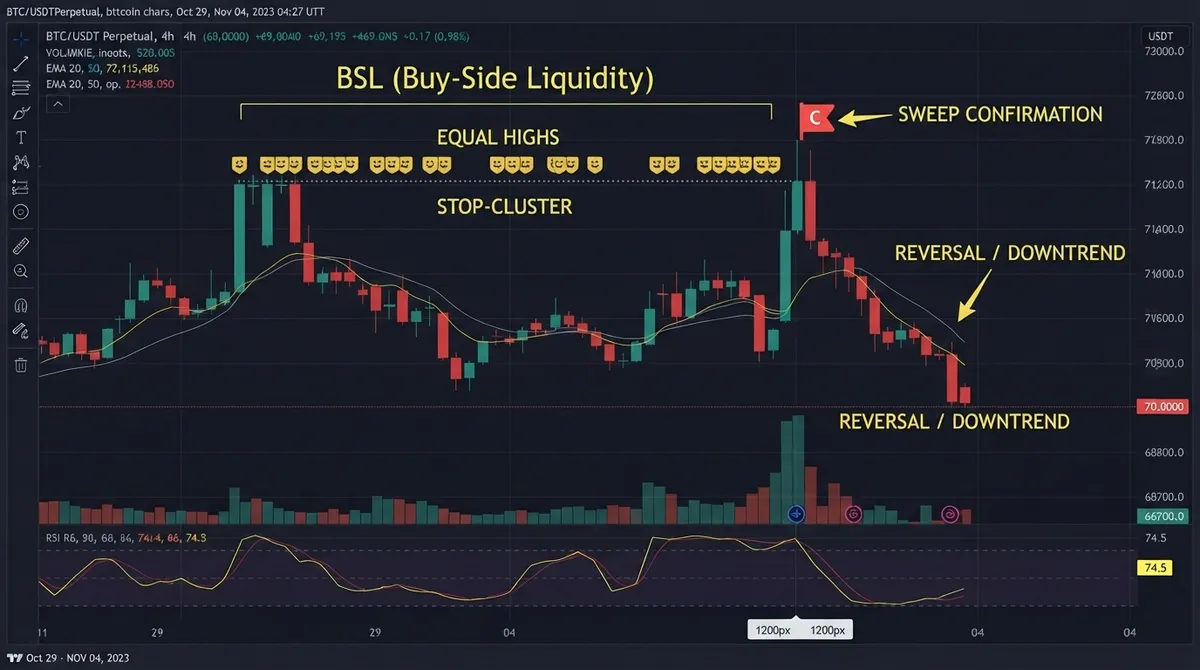
Large participants need counterparties to fill size. To sell a large position, they need buyers willing to absorb it — and a cluster of stop-triggered buy orders above a swing high is exactly that liquidity, delivered in a single, predictable location.
Why the Sweep Happens Before the Real Move, Not After
This is the part retail intuition gets backward. Traders assume price breaks a level because the real move is starting. In practice, the sequence is often reversed: price is pushed into a liquidity cluster specifically to fill orders, and only once that liquidity has been consumed does the genuine directional move begin. The sweep isn't a symptom of the move — it's a precondition for it. Institutions require the exit liquidity from your stop before they can commit to the opposite direction at scale.
The Difference Between a Sweep and a Breakout
Both look identical in the first few seconds: price pushes through a prior high or low. The distinction only becomes visible in what happens immediately after:
- A genuine breakout continues with sustained displacement, holds above/below the broken level on a retest, and is typically backed by expanding volume in the direction of the break.
- A liquidity sweep produces a sharp wick beyond the level, followed by an immediate, aggressive rejection back through it — the market took the liquidity it needed and had no further interest in sustaining price at that extreme.
The single tick that "shouldn't have" hit your stop is rarely random. It's usually the minimum distance required to trigger the resting cluster before the reversal, which is precisely why placing stops at the "obvious" distance beyond a level puts you inside the zone being targeted, not outside it.
The Bridge: How the Liquidity Grab Engine Maps This Before It Happens
Manually identifying where liquidity is resting requires constantly scanning for equal highs, equal lows, and untested swing points across every timeframe you trade — and then correctly judging, in real time, whether a break of that level is a sweep or a genuine continuation. This is a pattern-recognition task under time pressure, which is exactly where discretionary judgment breaks down during live trading.
Why this specific concept benefits from automation: liquidity mapping is objective — equal highs/lows and untested swing points are measurable, not a matter of interpretation — but the follow-through judgment (sweep vs. breakout) depends on reading displacement and rejection speed correctly, under pressure, in the seconds after the level breaks. That combination of "objective input, time-sensitive judgment" is exactly what a rules-based tool handles better than a stressed trader watching a live candle.
The Liquidity Grab Engine addresses both halves of this:
- Pool identification — automatically marks BSL and SSL clusters at equal highs/lows and untested swing points, so you know in advance where the market is likely to be drawn to.
- Sweep confirmation — flags when a marked pool is taken, and distinguishes a rejection-based sweep from a level that's actually being broken with genuine displacement.
- Post-sweep bias — surfaces the expected reversal direction once a sweep is confirmed, based on the same footprint logic (displacement, imbalance) used to validate order blocks.
The goal isn't to predict every sweep in advance — it's to stop being surprised by them, and to reposition your own stop placement and entries around where the liquidity actually sits, rather than where it "looks safe" on a static chart. This same mechanic is also why premature countertrend positions get cleared out so reliably, covered in why trading against the higher timeframe trend is costing you money.
Execution: How to Read the Indicator on Your Chart
- Identify marked liquidity pools before you set your stop, not after. If the engine shows a BSL/SSL cluster near your intended stop level, treat that as a warning that you're placing your risk directly inside the target zone, not beyond it.
- Wait for sweep confirmation before treating a level break as directional. A level tagged by the engine that gets swept and immediately rejected should be read as a liquidity event, not a trend signal — don't chase the wick.
- Use the post-sweep bias flag to time entries, not the sweep itself. The highest-probability entry is typically after the reversal confirms with displacement, not at the exact tick the sweep occurs — the engine's bias flag is there to help you wait for that confirmation instead of reacting to the wick in real time.
Frequently Asked Questions
Why does my stop loss always get hit right before the market reverses?
Because your stop is likely resting in the same location as many other retail stops — just beyond an obvious swing high or low. That cluster is attractive liquidity for larger participants who need it filled before they can move price in the opposite direction, which is why the reversal so often follows immediately after the sweep.
How do I place a stop loss to avoid getting hunted?
Rather than placing a stop at the "standard" distance beyond a visible high or low, place it beyond the liquidity pool itself — past the cluster of equal highs/lows or the wick extreme of a recent sweep — so your stop sits outside the zone that's likely to be targeted, not inside it.
Are stop hunts more common in crypto than in forex or stocks?
Crypto's fragmented liquidity across exchanges and higher retail participation make equal highs/lows and round-number levels particularly dense with resting stops, and the market's 24/7 nature means these sweeps can occur at any hour without the natural pauses session-based markets have. The underlying mechanic is the same across markets — crypto simply offers more frequent, less predictable opportunities for it.
Ready to Stop Getting Swept?
Knowing where liquidity is resting — before price gets there — is the difference between being the liquidity and trading around it.
Ready to implement this institutional logic? Deploy the Liquidity Grab Engine on your charts now.