
How to Scalp Bitcoin Futures Without Getting Chopped Up by Spread and Slippage
Introduction: Your Analysis Was Right. Your Fill Wasn't.
The setup was correct. Direction was right. And the trade still lost money, because the price you actually got filled at wasn't the price you saw when you clicked. On a swing trade targeting several hundred points, a few ticks of slippage barely register. On a scalp targeting a fraction of that, the same few ticks can consume a meaningful share of the entire intended profit before the trade has even started moving in your favor.
This is a distinct problem from signal quality. You can have a perfectly filtered, genuinely high-probability setup and still lose money consistently if the execution cost attached to every entry and exit eats a disproportionate share of a small target. This post covers what actually causes slippage on Bitcoin futures specifically, why the common fix of tightening your stop doesn't address it, and what a reliable execution approach actually requires.
The Core Logic: Why Spread and Slippage Hit Scalpers Disproportionately Hard
Fixed Costs, Shrinking Targets
Spread and slippage are, in absolute terms, roughly similar whether you're targeting a large swing move or a small scalp — a few ticks of adverse fill price is a few ticks regardless of your intended profit distance. The problem is proportional, not absolute. On a swing trade targeting a move worth many multiples of the typical spread, that cost is a rounding error. On a scalp targeting a move only a few multiples larger than the spread itself, the same fixed cost can represent a substantial percentage of the entire target — meaning a strategy with a genuinely favorable win rate can still be unprofitable once execution costs are accounted for at this scale.
What Actually Causes Slippage on Bitcoin Futures
Slippage isn't random — it has identifiable causes, several of which are specific to how crypto futures order books behave:
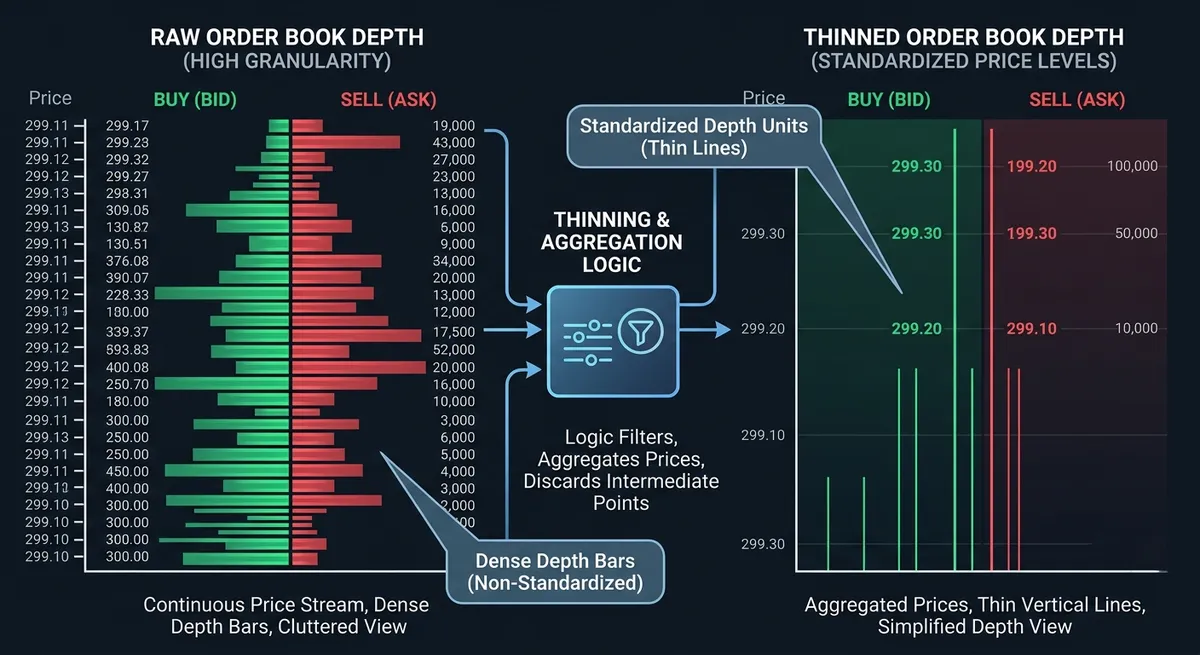
- Order book depth thinning during volatile moves. Resting limit orders near the current price get consumed rapidly during fast moves, meaning a market order placed during high volatility has to reach further into the book to get filled, at progressively worse prices, than the same order placed during calmer conditions.
- Liquidation-driven volatility bursts. The same liquidation cascades covered in why scalping crypto feels impossible on the 1-minute chart don't just produce misleading structural signals — they're also exactly when order book depth is thinnest, because the cascade itself is consuming resting liquidity as it unfolds. Entering during one of these windows compounds a bad signal read with a bad execution price simultaneously.
- Cross-exchange price discrepancies. The reference price shown on an aggregator or a different exchange's chart can diverge from the actual executable price on the venue you're trading, particularly during fast moves — meaning the "current price" you're reacting to isn't necessarily the price available to you in that moment.
Why Entering During the Signal Is Often the Worst Time to Execute
This produces a specific compounding problem for scalpers: the exact conditions that generate the most visually compelling, fast-looking signals — sharp, sudden price movement — are frequently the same conditions where order book depth is thinnest and slippage is worst. A trader reacting immediately to a fast-looking move is often entering at precisely the moment execution quality is at its lowest, which means the most "exciting" signals are disproportionately likely to also be the most expensive to actually trade.
Why Tightening Your Stop Isn't the Fix
The common response to a poor cost-to-target ratio is to tighten the stop further, on the assumption that a smaller stop improves the ratio between risk and the execution cost being paid. This doesn't address the underlying problem — it increases the probability of getting stopped out by ordinary spread and short-term noise alone, independent of whether the trade thesis was correct. A tighter stop doesn't reduce slippage; it just reduces the amount of adverse movement, including movement caused by the spread itself, that the position can tolerate before being closed. This often produces a higher rate of being stopped out on trades that would have eventually worked, without improving the actual execution cost per trade.
What Reliable Execution Actually Requires
Addressing this requires checking two separate things together, not adjusting stop distance alone: whether the signal itself reflects genuine displacement rather than liquidation-driven noise, covered in depth in the low-timeframe noise post, and whether current market conditions — order book depth, recent volatility — support a reasonable execution price at the moment of entry. A genuine signal executed into thin, cascade-driven liquidity still produces a poor outcome, and favorable liquidity conditions don't make a noise-driven signal worth trading. Both checks matter, and neither substitutes for the other.
The Bridge: How the High-Frequency Scalper Times Execution, Not Just Signals
Filtering signal quality — the focus of the 1-minute chart noise post — addresses whether a setup is worth taking. It doesn't, on its own, address whether the moment you'd enter is a moment where you can actually get a reasonable fill. These are separate problems that both need to be solved for scalping to be viable on an instrument like Bitcoin futures, where execution conditions can shift within seconds. This also connects to the leverage and liquidity mechanics covered in the best indicator for catching stop hunts on Binance and Bybit futures — the same liquidation clustering that drives stop hunts is a direct contributor to the thin-liquidity windows that produce the worst slippage.
Why execution timing specifically benefits from automated flagging rather than manual judgment: by the time a trader visually notices that a move looks fast and volatile, the order book conditions behind that move have often already deteriorated — there's no useful reaction window for a human to assess depth conditions between noticing a signal and placing an order at scalping speed.
The High-Frequency Scalper addresses this by:
- Separating signal timing from execution timing — flagging a valid setup separately from confirming that current order book conditions support a reasonable entry price.
- Cascade-window avoidance — cross-referencing the same liquidation-spike detection used for signal filtering to also flag periods of thin, cascade-driven liquidity as poor execution windows.
- Post-burst entry sequencing — where appropriate, favoring entries after an initial volatility burst has passed and depth has partially recovered, rather than into the burst itself.
- Execution-quality context alongside signal alerts — presenting both pieces of information together, so a genuine setup during poor execution conditions is visibly distinct from the same setup during favorable ones.
Execution: How to Read the Indicator on Your Chart
- Check that the liquidation-window flag is clear before entering, even on a valid signal. A genuine setup occurring during a flagged thin-liquidity window still carries elevated execution risk — treat the flag as a reason to wait for conditions to normalize, not just a note.
- Avoid market-ordering into a fast, unconfirmed move regardless of how compelling it looks. The fastest-looking moves are disproportionately likely to coincide with the worst execution conditions — let the tool's post-burst sequencing guide entry timing rather than reacting to the initial spike.
- Don't substitute a tighter stop for waiting on execution confirmation. If the setup and execution conditions haven't both been confirmed, reducing stop distance doesn't fix the underlying cost problem — it only changes how quickly a valid trade gets closed out by noise.
Frequently Asked Questions
Why do I keep getting bad fills when scalping Bitcoin futures?
Bad fills typically occur when order book depth is thin relative to your order size, which happens disproportionately during fast, volatile moves — including liquidation cascades, which consume resting liquidity as they unfold. Entering immediately during these windows, rather than waiting for depth to recover, is the most common cause of consistent slippage.
Does using a tighter stop loss reduce slippage on scalp trades?
No — a tighter stop reduces the amount of adverse movement a position can tolerate before closing, but it doesn't change the execution price you receive on entry or exit. It often increases how frequently valid trades get stopped out by ordinary noise and spread, without addressing the underlying execution cost.
What causes slippage on crypto futures exchanges specifically?
The main contributors are thinning order book depth during volatile moves, liquidation-driven cascades that consume resting liquidity as they occur, and price discrepancies between the reference price shown on charts or aggregators and the actual executable price on the exchange in fast-moving conditions.
Ready to Stop Paying for Bad Timing on Good Signals?
A correct trade idea executed into the worst possible liquidity conditions produces the same outcome as a wrong one — the fix isn't a smaller stop, it's separating whether a setup is valid from whether right now is actually a reasonable moment to trade it.
Ready to implement this institutional logic? Deploy the High-Frequency Scalper on your charts now.