
Best Indicator to Catch Stop Hunts on Binance and Bybit Futures Before They Happen
Introduction: Leverage Doesn't Just Amplify Gains — It Amplifies the Hunt
On spot markets, a stop hunt costs you a position. On leveraged futures, the same wick can cost you the position and trigger a liquidation cascade that accelerates the very move you were trying to avoid. The mechanic is identical to spot — a cluster of resting stops gets swept before the real move — but the consequences compound faster, because liquidations themselves become additional forced orders that feed the move.
This is why crypto futures traders specifically need more than a general awareness of stop hunts. They need a tool that flags where liquidity is resting before price gets there, because on a leveraged position, reacting after the fact is often too late.
The Core Logic: Why Futures Markets Are Especially Prone to This
Leverage Creates Predictable Liquidity Clusters
Liquidation levels aren't random — they cluster at predictable distances from entry based on common leverage tiers (5x, 10x, 20x, 25x, 50x). This means that beyond ordinary stop-loss clustering at swing highs/lows, leveraged futures markets carry an additional, highly concentrated layer of forced-exit liquidity sitting at specific price distances from where large positions were opened. A move that reaches one of these clusters doesn't just trigger stops — it triggers forced liquidations, which are themselves market orders that add fuel to the move in progress.
Round Numbers Matter More on Futures
Round-number price levels attract disproportionate stop and liquidation clustering on leveraged instruments, partly because retail position sizing and grid/DCA bot configurations tend to reference clean numbers rather than precise technical levels. On a leveraged futures chart, a round number a small distance beyond a recent high or low is often a denser liquidity target than the technical level itself.
Fragmented Liquidity Across Venues
Price and order book depth differ slightly across Binance, Bybit, OKX, and Bitget at any given moment. A sweep can occur on one venue's order book before it's visible on another, and funding rate differentials between exchanges can incentivize exactly the kind of aggressive positioning that produces these sweeps in the first place. Traders watching only one exchange's chart are working with a partial picture of where the broader liquidity actually sits.
What "Best" Actually Means for This Job
For catching stop hunts specifically on leveraged crypto futures, an indicator needs to satisfy criteria that a general-purpose liquidity tool built for slower markets doesn't need to:
- Non-repainting pool marks — a level that shifts retroactively is useless when you're managing real-time leverage exposure.
- Round-number and swing-point detection together — liquidation clustering means both matter, not just technical swing highs/lows.
- Fast sweep confirmation — on a leveraged position, the delay between a sweep occurring and you noticing it is itself risk exposure.
- Multi-timeframe visibility — futures scalpers and swing traders are hunting liquidity at different structural levels, and the tool needs to serve both without requiring separate setups.
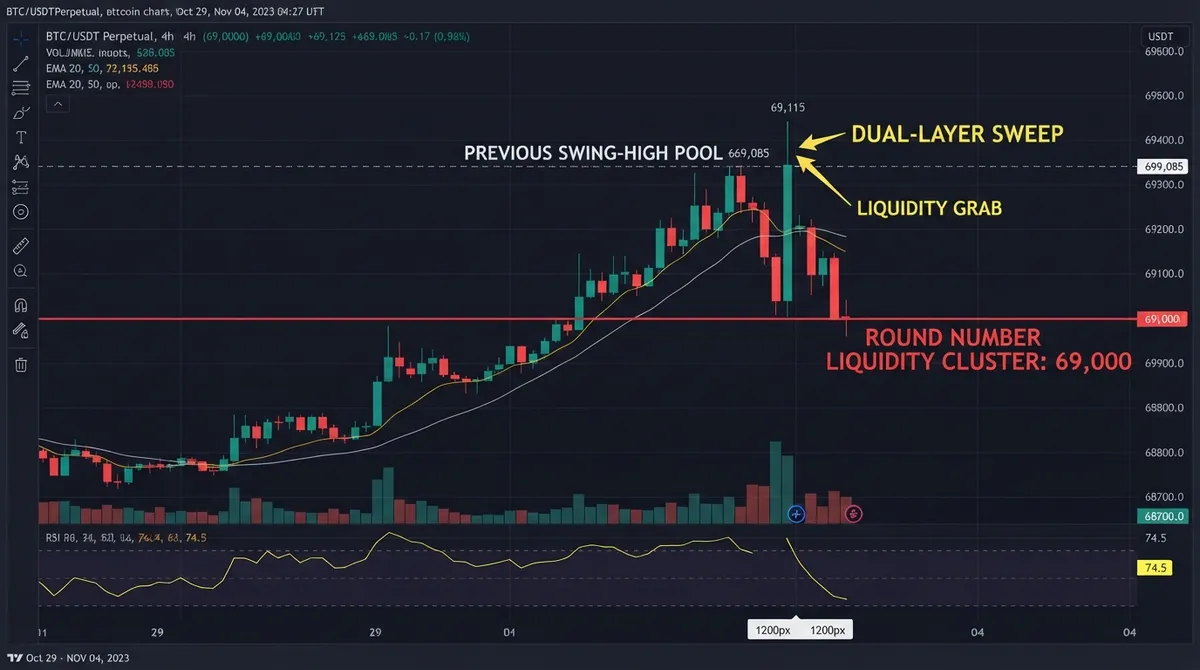
The Bridge: How the Liquidity Grab Engine Is Built for This Specific Risk
Why this matters more for futures than spot: on spot, a missed sweep read costs you a trade. On leveraged futures, it costs you the trade and increases the odds you're one of the forced orders adding fuel to someone else's read. The margin for reacting late is smaller, which makes automated, non-repainting detection a higher-priority tool for futures traders than for spot traders running the same strategy.
The Liquidity Grab Engine applies its pool-identification and sweep-confirmation logic — covered in depth in how to identify a liquidity grab vs. a breakout — with the added weight that on a leveraged position, confirmation speed and reliability matter more than on an unleveraged spot trade:
- Dual-layer pool marking — flags both technical swing-based liquidity (equal highs/lows) and round-number clusters, since leveraged futures markets respond to both.
- Non-repainting confirmation — once a sweep is tagged, the mark doesn't move retroactively, which matters when you're deciding whether to hold, reduce, or add to a leveraged position in real time.
- Cross-timeframe pool tracking — surfaces liquidity levels relevant to both scalping and swing timeframes simultaneously, since futures traders often need to be aware of both a nearby scalp-level pool and a larger structural one at the same time.
Whether you're trading futures on Binance, Bybit, OKX, or Bitget, the underlying mechanic — resting liquidity being targeted before a real move — doesn't change. What changes is how much that liquidity matters to your position, which is exactly why futures traders get disproportionate value from having it flagged in advance rather than discovered after the fact.
Execution: How to Read the Indicator on Your Chart
- Check both swing-based and round-number pools before setting leverage-adjusted stops. If a round-number cluster sits close to your intended liquidation price, treat that as a warning sign independent of where the nearest technical level is.
- Don't add to a position on an unconfirmed sweep. Wait for the engine's non-repainting confirmation before treating a wick through a marked pool as your cue to re-enter or increase size — a leveraged add on an unconfirmed read compounds the risk of being wrong.
- Cross-check the scalping-timeframe pool against the swing-timeframe pool before sizing. A scalp entry that ignores a larger structural liquidity level just beyond it is exposed to a bigger sweep than the chart in front of you suggests.
Frequently Asked Questions
What's the best indicator for catching stop hunts on crypto futures specifically?
Look for one that marks both swing-based and round-number liquidity clusters, confirms sweeps without repainting, and works across multiple timeframes simultaneously — leveraged futures markets respond to liquidity in ways general-purpose spot tools aren't built to flag. The Liquidity Grab Engine is built specifically around these three requirements.
Are stop hunts more common on futures than on spot markets?
The underlying mechanic is the same, but futures markets add liquidation clustering on top of ordinary stop clustering, which means there's more concentrated forced-exit liquidity at predictable distances from common entry and leverage levels — making sweeps both more frequent in effect and more consequential when they occur.
Does it matter which exchange I trade futures on — Binance, Bybit, OKX, or Bitget?
The core stop-hunt mechanic applies across all of them, though order book depth and funding rates differ slightly venue to venue, which can shift exactly where and when a sweep occurs. Watching liquidity structure rather than a single exchange's price action in isolation gives a more complete picture regardless of which platform you execute on.
Ready to Stop Reacting to Liquidations After They Happen?
On leveraged futures, the cost of noticing a sweep late isn't just a bad entry — it's compounding exposure while you figure out what just happened.
Ready to implement this institutional logic? Deploy the Liquidity Grab Engine on your charts now.