
What Is a 'Naked POC' and Why Does Price Always Come Back to It?
Introduction: The Level Nobody Marked, But the Market Remembers
A single price level from three sessions ago, one nobody drew a line on, one that isn't a swing high or a round number or an obvious support zone — and price returns to it with unusual precision, reacting exactly at that level as if it had been marked all along. It wasn't randomly significant. It was where the previous session's volume concentrated more than anywhere else, and until price came back to trade through it, that concentration remained untouched.
This is a Naked Point of Control, and it behaves differently from the price-imbalance concepts covered elsewhere on this site — not because the underlying "the market returns to unfinished business" principle is different, but because the mechanism generating that unfinished business is volume-based consensus rather than a fast, one-sided move. This post covers exactly what a POC is, what makes one "naked," and why these levels function as genuine, checkable magnets rather than a coincidental pattern.
The Core Logic: What a Naked POC Actually Represents
What a Point of Control Is
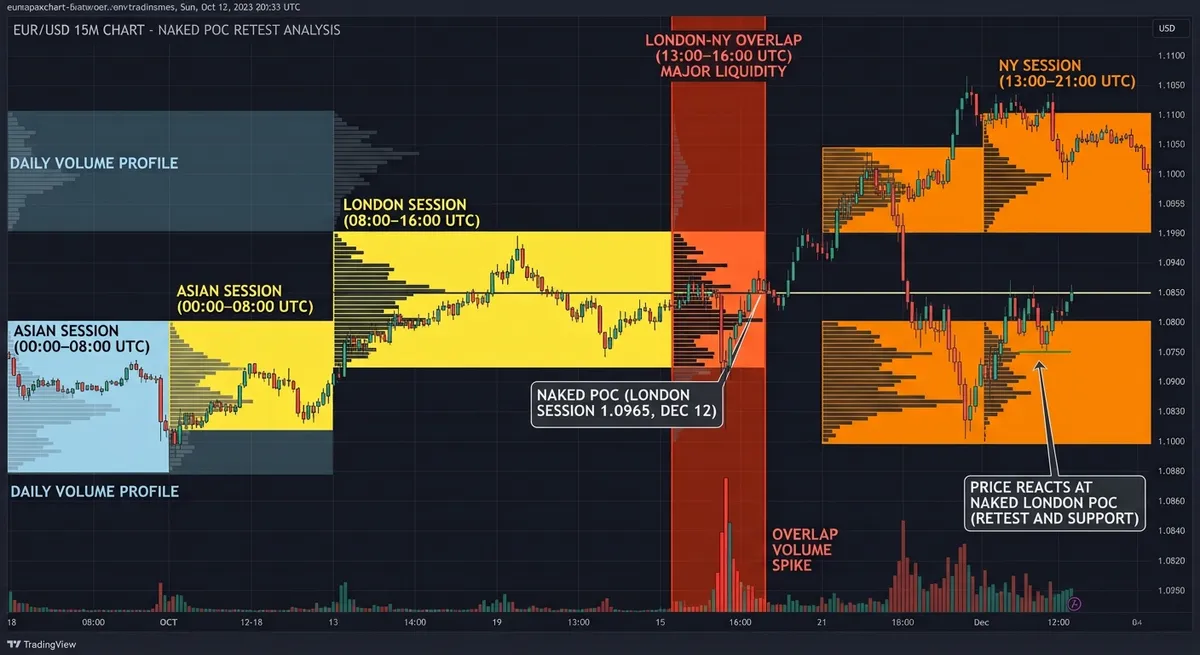
The Point of Control (POC) is the single price level within a given session or period's volume profile where the most trading volume occurred — the price the market spent the most time and participation actually transacting at, out of every level traded during that period. This is distinct from where price simply visited briefly; the POC specifically identifies where sustained agreement on value was highest, based on actual traded volume rather than price movement alone.
What Makes a POC "Naked"
A POC becomes "naked" when subsequent price action has not yet traded back through that exact level. It remains untested — the volume concentration that defined it as significant hasn't been revisited or absorbed by later activity. This is a narrower, more precise concept than an untested support or resistance zone generally: a naked POC refers specifically to the single most significant volume node from a prior period, not a broader price range.
Why Naked POCs Function as Magnets
The pull toward a naked POC operates on a similar underlying principle to the Fair Value Gap rebalancing covered in why price keeps filling the fair value gap and reversing — the market has unfinished business at that level — but the mechanism generating that business is different. An FVG represents a price range the market moved through too quickly to trade properly. A naked POC represents the opposite: a price the market traded at extensively and, by that heavy participation, effectively agreed was fair value at the time. Two forces pull price back toward it: participants who transacted heavily at that level during the original session have reference points anchored there, and algorithmic execution and mean-reversion-oriented strategies specifically track untested high-volume nodes as statistically likely targets for renewed trading interest, precisely because the level already demonstrated it can attract substantial participation once.
POC vs. Value Area High and Low
The POC is a single price point — the most significant node in the profile. The Value Area High (VAH) and Value Area Low (VAL) define the boundaries of a broader range, typically containing a large majority of the period's total volume, with the POC sitting somewhere inside that range. A naked POC pull is a more precise, higher-conviction target than a move toward the value area edges, because it identifies the exact price of peak consensus rather than the outer boundary of a wider zone. Both are useful, but they answer different questions: VAH/VAL describe the range the market generally accepted as fair; the POC identifies the single price within that range where agreement was strongest.
Why Naked POCs Don't All Carry Equal Weight
Not every naked POC deserves equal attention, which is why treating "naked" alone as sufficient justification for a trade misses important context. A naked POC sitting close to current price, with no strong trending structure between here and there, represents a more immediately relevant magnet than one buried several strong impulse legs away, where a sustained trend has moved price decisively past it. Additionally, when multiple consecutive sessions leave naked POCs clustered near the same price area, that clustering represents a denser concentration of historical agreement than any single naked POC alone — a stacked cluster is generally a stronger magnet than an isolated one. Reacting to the presence of a single naked POC without checking its distance from current price, the structure in between, and whether it sits within a broader cluster is treating a nuanced, multi-factor concept as a single binary flag.
The Bridge: How Session Volume Profile Tracks This Automatically
Manually tracking every prior session's POC, monitoring whether each one has since been tested, and identifying when multiple untested POCs are clustering near the same price area requires maintaining a running historical record across sessions — not a single-chart read, and not something most traders keep current by hand across more than a session or two back.
Why this specific concept benefits from continuous tracking rather than a periodic manual review: a POC's relevance depends entirely on its current tested/untested status, which only changes at the moment price actually trades through it — meaning the tracking has to be continuous and cumulative across sessions, not something recalculated fresh each time you happen to look. This connects to the same real-time volume tracking covered in the best time of day to trade crypto for volume — that post covers reading current session participation; this is what happens to the volume record left behind once a session ends.
Session Volume Profile addresses this by:
- Automatic POC identification per session — calculates and marks the Point of Control for each completed session without requiring manual volume analysis.
- Naked/tested status tracking — continuously monitors whether price has traded back through each historical POC, updating its status the moment it's revisited rather than requiring a manual check.
- VAH/VAL boundary display alongside the POC — showing both the precise node and the broader value area together, so the distinction between the two isn't lost.
- Cluster detection across sessions — flagging when multiple naked POCs from consecutive periods sit near the same price area, surfacing the stronger, stacked-magnet condition rather than treating each session's POC in isolation.
Execution: How to Read the Indicator on Your Chart
- Check the naked/tested flag before treating any historical POC as relevant. A POC already marked as tested has had its original volume concentration addressed — weight it lower than one still flagged naked.
- Prioritize clustered naked POCs over isolated ones. When the tool shows multiple untested POCs stacking near the same price area, treat that zone as a stronger magnet than a single naked POC with no supporting cluster nearby.
- Weigh distance and intervening structure before treating a naked POC as an immediate target. A naked POC close to current price with limited structure in between deserves more near-term attention than one sitting behind a strong, still-intact trending move away from it.
Frequently Asked Questions
What is a naked Point of Control in trading?
A naked Point of Control is the single highest-volume price level from a previous session or period that price has not yet traded back through. It remains "naked" until subsequent price action revisits and trades through that exact level, at which point it's considered tested or filled.
How is a naked POC different from the Value Area High or Low?
The POC identifies a single, precise price level representing the point of maximum volume concentration, while the Value Area High and Low mark the boundaries of a broader price range containing the majority of a period's total volume. A naked POC pull is generally a more precise, higher-conviction target than a move toward the wider value area edges.
Do naked POCs always get filled eventually?
Not with equal reliability. A naked POC close to current price with limited structure in between tends to get revisited more reliably than one sitting behind a strong, sustained trend that has moved price decisively away from it. Multiple naked POCs clustering near the same price area also tend to act as stronger, more reliable magnets than an isolated one.
Ready to Stop Missing the Levels Nobody Marked?
A naked POC isn't a coincidence you'd have to get lucky to notice — it's a specific, trackable record of where the market already agreed on value once, sitting untested until price finishes that business.
Ready to implement this institutional logic? Deploy the Session Volume Profile on your charts now.