
Why Price Keeps Reversing Exactly at the POC (and How to Trade the Bounce)
Introduction: The Level Keeps Winning, and It's Not a Coincidence
Price approaches a level, reverses. Comes back an hour later, reverses again from almost the exact same print. A third time, same result. It isn't a support or resistance line you drew — it's the point of control (POC), and it's acting less like a historical reference and more like a magnet the market can't seem to move away from for long.
That behavior isn't random and it isn't the POC being "sticky" in some vague sense. In range-bound conditions specifically, the POC represents the price where the most volume has transacted — the price both buyers and sellers have most recently agreed is fair. While the market stays in a range, that agreement doesn't expire after one touch. It keeps getting re-tested because it keeps being the price where the most participants are willing to transact, which is a fundamentally different mechanism than a level simply being remembered.
There's also a specific reason this can be confusing to research on your own: a lot of the content available on POC behavior is actually describing a different scenario — a naked, untested POC from a completed prior session, which behaves according to different logic than a live POC being repeatedly defended inside a current range. Getting these two conflated is part of why the "POC as magnet" idea can feel inconsistent — because two different mechanisms are being described as if they were one.
This post covers why the POC behaves like a live, active equilibrium during range conditions rather than a static historical marker, what has to be true about market structure for that reversion behavior to hold, and how this specific behavior differs from a separate POC concept — the naked, untested POC from a prior session — covered elsewhere on this site.
The Core Logic: The POC as a Live Equilibrium
POC as a Live Equilibrium, Not Just a Historical Marker
Most explanations of the point of control describe it as the price with the highest traded volume within a completed session — a historical fact about where the most business got done. That's accurate, but it undersells what happens while the session is still developing and the market is range-bound. In that condition, the POC isn't fixed at the end of a period looking backward; it updates continuously as new volume prints, and it represents the market's current best estimate of fair value in real time, not just a record of where fair value used to be.
Why Range-Bound Conditions Make the POC a Magnet
A POC only behaves like a reversion magnet when the broader condition is genuinely ranging — when there's no active break of structure (BOS) pushing price into new territory and no active displacement resolving the imbalance that would otherwise pull price away. In a ranging market, price oscillating between the range extremes has no directional reason to settle anywhere except the price where the most volume has already transacted, because that price represents the point of least resistance for continued trade. Move price away from the POC without new information to justify a genuinely new equilibrium, and the path of least resistance is back toward it.
This is also why the effect tends to strengthen the longer a range persists without resolving. Each additional touch and reversal at the same price adds more volume to that level's tally, which reinforces its status as the point of least resistance for the next oscillation. A range that's been intact for many hours with repeated POC reactions has, in effect, been continuously voting for the same fair price — which is part of why the reaction can look almost mechanical by the third or fourth touch, even though nothing about the underlying mechanism has changed from the first touch to the latest one.
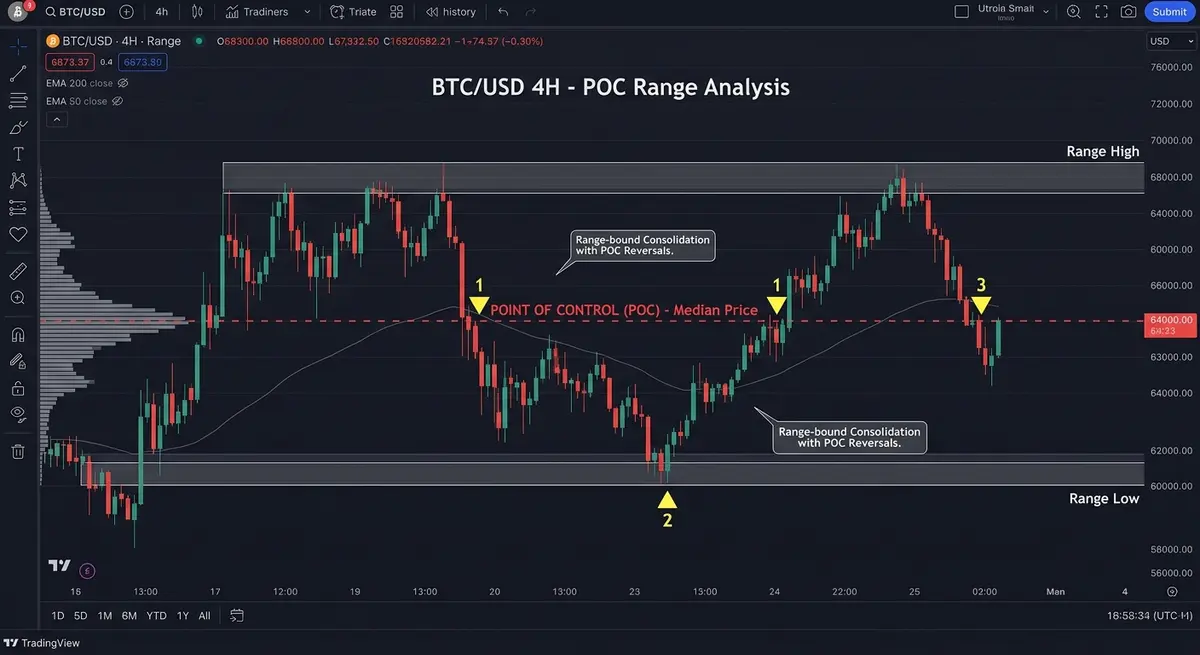
Fair Value vs Fair Price: Why Participants Keep Transacting at the Same Level
The reason volume concentrates at one price rather than distributing evenly across the range comes down to where both sides of the market — buyers willing to buy and sellers willing to sell — currently agree value sits. That agreement doesn't need every participant to consciously target the POC; it emerges from the aggregate of resting limit orders, market participants fading extremes, and algorithmic execution that tends to transact more heavily near a perceived fair price than at the edges of a range. As long as nothing changes the underlying supply/demand balance, each new attempt to move away from that price runs into the same resistance that formed it in the first place.
The Difference Between a POC Bounce and a Naked POC Fill
It's important to distinguish this behavior from a separate, commonly discussed POC concept: the naked or untested POC, which refers to a POC from a prior, completed session that price hasn't revisited yet. A naked POC is treated as a magnet for a different reason — it represents unfinished business from a prior period, and price is expected to eventually return to test it once. The live, in-session POC reversion covered in this post is a different mechanism entirely: it's not about an old, untested level pulling price back for a first visit, it's about an active, currently-developing equilibrium getting repeatedly defended in real time while the range persists. Confusing the two leads to applying naked-POC logic (expect one eventual test) to a situation that actually calls for range-reversion logic (expect repeated tests as long as the range holds).
Why a POC Reaction Alone Isn't a Full Setup
Even a clean POC reversion has conditions attached. The reaction only holds while the range itself holds — once price closes decisively beyond the value area high or low (VAH/VAL) with genuine displacement, the range is broken and the reversion logic no longer applies, regardless of how many times the POC held previously. Trading every POC touch the same way without checking whether the range is still structurally intact is how a reliable-looking pattern turns into a loss the one time the range actually resolves.
The number of prior successful touches doesn't tell you when the range will break — if anything, a range that's held for an unusually long time is building up more potential energy for the eventual resolution, not less. Treating "it's bounced four times already" as a reason to increase confidence on the fifth touch, without independently checking whether the VAH/VAL boundaries are still intact and whether higher-timeframe structure still supports a range, is the exact point where a sound mean-reversion read turns into overconfidence.
The Bridge: How Session Volume Profile Solves This
Reading this correctly in real time requires tracking two things simultaneously: where the live POC currently sits as volume develops, and whether the broader condition is still genuinely ranging or has started to resolve into a trend. Doing both by eye, on a fast-moving intraday chart, is exactly the kind of dual-tracking that breaks down under time pressure.
Session Volume Profile is built to surface both pieces together rather than leaving the range-versus-trend judgment to a manual read:
- Real-time POC tracking as volume develops — the point of control updates live within the active session, so the reversion target reflects current equilibrium rather than a stale endpoint from a completed period.
- Range-regime detection — the indicator flags whether current conditions read as ranging or trending, which is the condition that determines whether POC-reversion logic applies at all.
- VAH/VAL boundary tracking — surfacing the value area edges alongside the POC, so a decisive close beyond either boundary is visible as the signal that the range — and the reversion logic built on it — may no longer hold.
- Session-type labeling — distinguishing an actively developing session's live POC from a completed prior session's POC, so the two different mechanisms covered in this post aren't visually conflated on the same chart.
This is a genuinely different setup from the untested, prior-session POC scenario — for that angle specifically, including when and why an old POC eventually gets revisited after sitting untouched, see what is a naked POC. That post covers the untested-prior-session-POC case; this one covers live, range-bound reversion while a session is still developing.
Execution: How to Read the Indicator on Your Chart
- Confirm the range-regime flag reads "ranging" before trading a POC bounce. If the tool is flagging a trending or breakout condition instead, don't apply reversion logic to a POC touch in that environment.
- Check the live POC's current position before entering, not a snapshot from earlier in the session. The live POC can shift as volume develops, and trading against its current location rather than an earlier print changes both entry and target.
- Watch for a VAH/VAL close with displacement as your invalidation trigger. A decisive break of either boundary is the signal that the range has resolved and POC-reversion trades should stop until a new range establishes itself.
Frequently Asked Questions
Is the POC always a reliable level to trade off of? Only under range-bound conditions. Once the market breaks out of the range with genuine displacement, the POC that held repeatedly during the range loses its reversion behavior, because the equilibrium that produced it no longer reflects current supply and demand.
How is this different from trading a naked POC? A naked POC is an untested level from a prior, completed session that price hasn't revisited yet, and the expectation is a single eventual test. A live, in-session POC during a range is an actively developing equilibrium that gets repeatedly defended as long as the range persists — the mechanisms and the trading logic for each are different.
Why does the POC sometimes shift instead of staying fixed? Because during an active session, the point of control updates as new volume transacts — if a new price level accumulates more volume than the prior POC, the POC moves to reflect that. A shifting live POC is the tool correctly tracking a developing equilibrium, not an error.
Ready to Trade the Level the Market Keeps Coming Back To?
A level that gets defended three times in a row isn't luck — it's the market repeatedly agreeing on the same fair price, and that agreement is readable in real time, not just after the fact.
Ready to implement this institutional logic? Deploy the Session Volume Profile indicator on your charts now.