
Stop Manually Redrawing Order Blocks Every Candle Close
Introduction: The Zone You Marked an Hour Ago Is Already Wrong
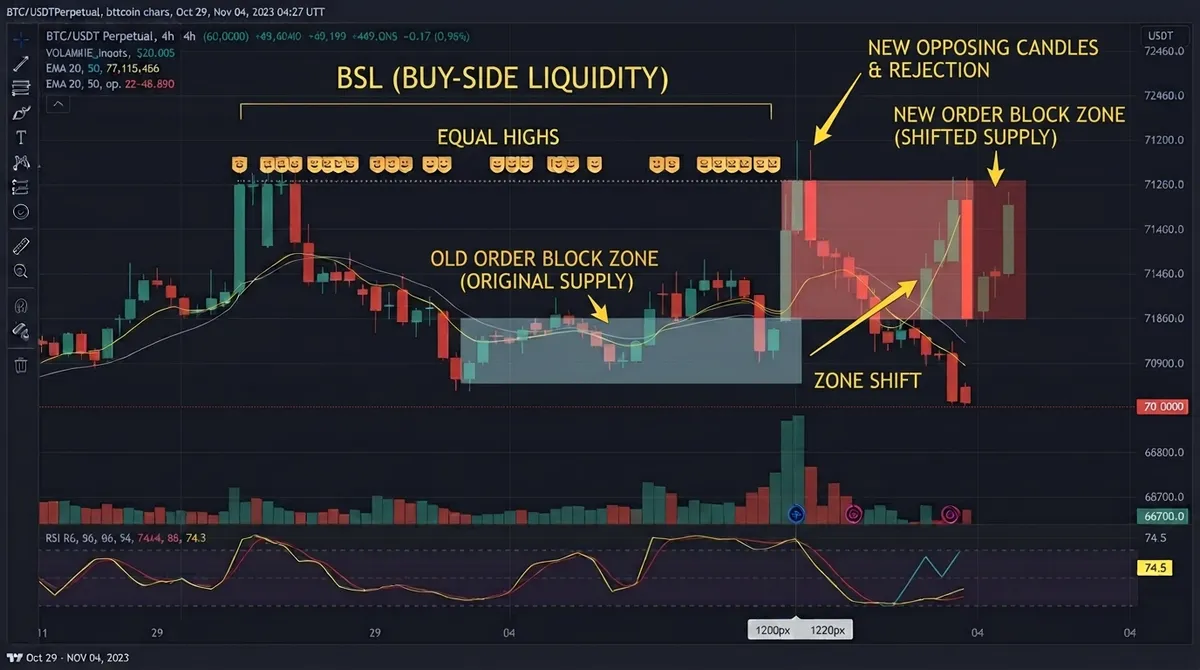
You mark an order block. Ten candles later, a deeper opposing candle forms inside the same leg, and the zone you drew is no longer the last opposing candle before displacement — it's outdated. You either catch it and redraw, or you don't, and you trade a stale zone as if it were still valid.
Multiply this across every pair on your watchlist, every timeframe you check, every session. Manual order block marking isn't just slow — it's structurally unstable. The zone's validity depends on price action that hasn't happened yet at the moment you draw it, which means every order block you mark by hand carries an expiration date you can't see until it's already passed.
This is the actual cost of manual marking: not the time spent drawing boxes, but the decisions made on zones that were already invalidated before the trade was taken.
The Core Logic: Why Manual Marking Breaks Down at Scale
The Zone Is a Moving Target
An order block's validity depends on three things happening in sequence: consolidation, displacement, and a break of structure. None of these are confirmed at the moment the candle prints — they're only confirmed after subsequent price action validates them. This means every order block you mark manually is provisional the instant you draw it. If a new, more recent opposing candle appears before the next break of structure, the "correct" order block has shifted — and unless you're re-checking that leg on every candle close, you won't notice.
Redrawing Isn't Optional — It's Structural
This isn't a matter of diligence. It's a mathematical consequence of how order blocks are defined. The zone is always the most recent qualifying candle before displacement, which means:
- Every new candle inside an active leg is a candidate for invalidating your current zone.
- Every timeframe you trade requires this check independently — a valid H4 zone doesn't tell you anything about whether the H1 zone nested inside it is still current.
- Every asset on your watchlist needs the same check, simultaneously, if you're trading more than one pair.
A trader manually managing five pairs across two timeframes is running this check up to ten times per candle close, continuously, for as long as the market is open. In crypto, where the market never closes, that check never stops.
The Real Failure Mode: Selective Attention
The practical failure isn't that traders never redraw — it's that they redraw inconsistently. You'll re-check the pair you're already watching closely and skip the ones you're not. This introduces a bias: you catch invalidations on setups you're emotionally invested in and miss them on setups you're not actively staring at, which means your review process is shaped by attention, not by the actual state of the market.
The Bridge: How Automated Order Blocks Removes the Redraw Problem Entirely
Automated Order Blocks doesn't just draw a zone once — it re-evaluates every active zone on every candle close, across every timeframe you have open, without requiring you to manually revisit a single chart.
Why automation is the correct tool for this specific problem: order block redrawing isn't a task that benefits from experience or discretion — it's a deterministic, rule-based check ("has a more recent qualifying candle appeared before the next BOS?"). That makes it a poor use of a trader's attention and an ideal use of a script. The tool applies the identical structural check every time, on every zone, with no drift in consistency between the pairs you're watching closely and the ones you're not.
Concretely, this means:
- Continuous re-validation — zones update automatically as new candles print, so you're never trading a box that's already been superseded.
- Simultaneous multi-asset coverage — the same check runs across your full watchlist at once, removing the selective-attention bias of manual review.
- Invalidation alerts — instead of you noticing a zone has shifted, the tool flags it, turning a task you had to remember into one you're notified of.
The underlying logic hasn't changed from a discretionary trader's approach — the tool applies the exact same rules a careful manual trader would. What changes is that it applies them with perfect consistency, at a frequency no manual process can sustain. For the filtering logic behind which zones are worth tracking in the first place, see why your order blocks keep failing.
Execution: How to Read the Indicator on Your Chart
- Treat every visible zone as current, not historical. Because the tool re-validates on each candle close, a zone still showing on your chart is confirmed live — you don't need to manually cross-check whether a newer candle has superseded it.
- Watch for invalidation flags before assuming a zone still holds. If a zone you were tracking disappears or is re-marked, that's the tool telling you a more recent qualifying candle has appeared — treat this as new information, not noise.
- Scan your full watchlist through the tool rather than chart-by-chart. Since the check runs uniformly across assets, use it to surface which pairs currently have a fresh, active zone rather than manually opening each chart to check.
Frequently Asked Questions
How often should an order block actually be redrawn?
In principle, on every candle close of the timeframe you're tracking, since each new candle is a potential invalidation event. In practice, this is why manual redrawing is unsustainable across more than one or two pairs — the check needs to run continuously, not periodically.
Does automatic order block detection work the same way as marking them manually?
Yes — a correctly built automated tool applies the same structural rules (consolidation, displacement, break of structure) that a discretionary trader would use. The difference isn't in the logic, it's in the consistency and frequency with which the check is applied.
Can I trust an automated order block indicator on crypto's 24/7 market?
Automation is arguably more necessary in crypto than in session-based markets precisely because there's no close to pause the check. A market that never stops requires a validation process that never stops either — which is not realistic to sustain manually over time.
Ready to Stop Redrawing and Start Trading?
The redraw problem isn't a discipline issue — it's a scale issue. No manual process holds up against a market that generates new invalidation conditions on every candle, across every pair, around the clock.
Ready to implement this institutional logic? Deploy the Automated Order Blocks on your charts now.