
How to Set Take-Profit Targets Using Liquidity Pools Instead of Guessing
Introduction: Your Target Was a Guess Dressed Up as a Number
You enter a trade with a clean setup behind it, then set your take-profit at a fixed multiple of your risk — 1.5R, 2R, whatever the plan calls for — because that's the rule. Price runs most of the way there, stalls well short of the target, and reverses. Or the opposite happens: price blows straight through your target and keeps running, leaving obvious profit on the table that a fixed multiple never accounted for.
Both outcomes point to the same underlying issue: a fixed risk-to-reward multiple describes your risk tolerance, not where the market is actually likely to go. Price doesn't move a specific multiple of your stop distance because that number is meaningful to it. Price tends to move toward the nearest significant pool of resting liquidity, because that liquidity is what the move is often mechanically drawn to reach. A target based on where that liquidity actually sits is a fundamentally different — and more information-rich — number than a target based on your own risk math alone.
There's a slightly uncomfortable implication buried in this: a fixed R:R target isn't a neutral, objective number the way it's often presented in risk management education. It's a personal risk-tolerance decision applied to a market question — "where is this move likely to end" — that has an actual, checkable answer sitting on the chart in the form of resting liquidity. Ignoring that answer in favor of a preset multiple isn't more disciplined; it's declining to use available information.
This post covers why liquidity pools function as statistically likely destinations rather than just danger zones to avoid, how to choose between a nearer pool and a more distant one when setting a target, and why a liquidity-based target still needs its own confirmation logic rather than being treated as automatically safe.
The Core Logic: Liquidity as a Destination, Not Just a Threat
Why Liquidity Pools Are Statistically Likely Targets, Not Just Danger Zones
Most retail education on liquidity focuses on the danger side of the concept — where your stop might get swept, where inducement might bait an early entry. That's accurate, but it's half the picture. The same buyside/sellside liquidity (BSL/SSL) that threatens your stop when you're positioned against it is exactly where price is statistically drawn to when you're positioned with the move. A pool of resting orders isn't just a risk to route around; once your trade is already positioned in the direction that would benefit from that liquidity being taken, it's a legitimate destination.
Draw on Liquidity: Why Price Gravitates Toward Resting Orders
The concept of "draw on liquidity" describes the market's tendency to move toward the nearest significant concentration of resting stop and limit orders, because that concentration represents genuine, executable interest that a move can transact against. A large pool of resting sell-side liquidity above current price represents real orders waiting to be filled; price moving up toward that pool isn't random drift, it's moving toward a location where substantial execution is available. This is the same underlying force that produces liquidity grabs in the first place — the destination side of that mechanism is exactly what a take-profit target should be built around.
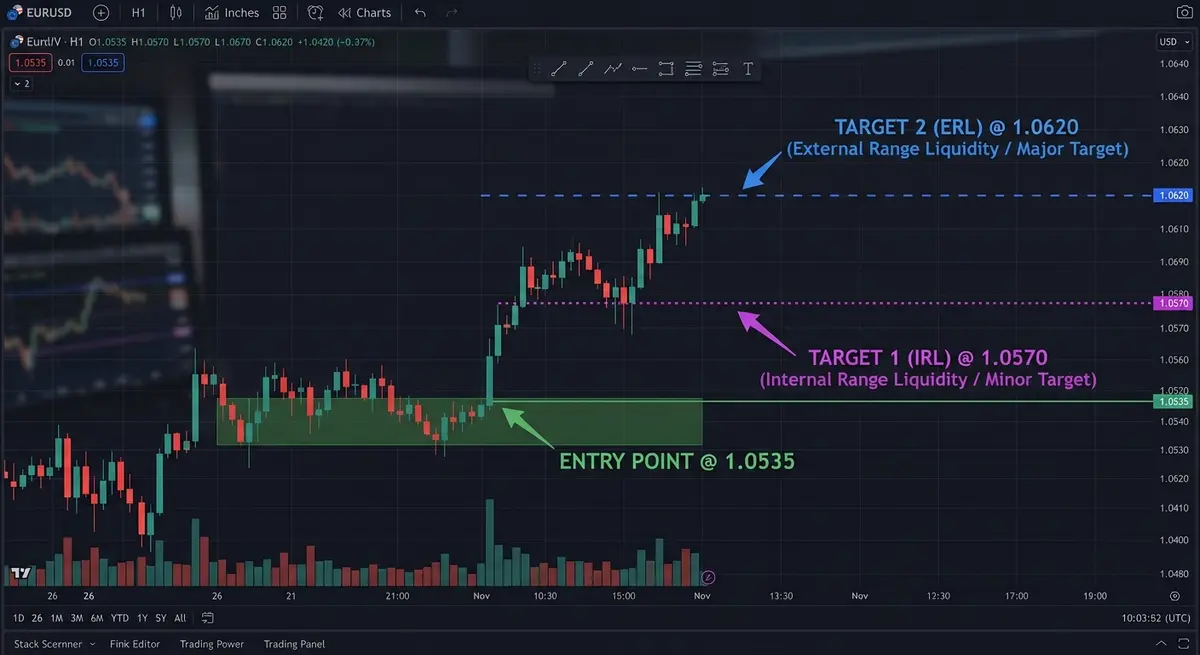
Internal vs External Liquidity as a Target-Selection Framework
Not every pool is an equally appropriate target for a given trade. Internal range liquidity (IRL) sits closer, inside the current range, and represents a more conservative, higher-probability but lower-reward target. External range liquidity (ERL) sits beyond the range extremes, representing a larger, lower-probability but higher-reward target that typically requires the range itself to break first. Choosing between them isn't about picking whichever is bigger — it's about matching the target to the strength of the setup: a marginal setup is better matched to the nearer internal pool, while a setup backed by strong higher-timeframe confluence has a better case for targeting the more distant external pool.
This framework also gives a natural way to scale out of a position rather than treating the choice as strictly either-or. A partial exit at the nearer internal pool, with the remainder held toward the external pool if structure continues to support it, captures the higher-probability portion of the move while still leaving room for the larger draw if the setup keeps confirming along the way.
Why a Fixed R:R Target Often Undershoots or Overshoots Real Liquidity
A fixed multiple like 2R is calculated purely from your entry and stop distance — it has no relationship to where actual liquidity happens to sit on that particular chart, on that particular day. Sometimes the nearest meaningful pool sits at 1.2R, meaning a 2R target overshoots into a zone with no real reason for the move to continue. Sometimes the nearest meaningful pool sits at 3.5R, meaning a 2R target closes the trade well before the level the move was actually likely headed toward. The fixed multiple isn't wrong as a risk management tool, but as a profit target it's disconnected from the actual mechanism driving how far the move tends to travel.
This mismatch is easy to miss because a fixed multiple will still produce winning trades fairly often — the target simply isn't optimized for where the move actually tends to end. Closing at 2R when the real draw sat at 3.5R still counts as a win; it's a win that left the more predictable portion of the move unclaimed, repeatedly, across every trade where the pattern holds. Over enough trades, that gap between "closed profitably" and "closed at the level the market was actually headed toward" compounds into a meaningful amount of foregone return.
Why Liquidity-Based Targets Still Need Confirmation and Invalidation Logic
Not every visible pool of liquidity is a reliable target. A pool that sits just beyond a minor, inducement-style level is a weaker draw than one backed by a genuinely significant prior high or low, and a pool sitting on the far side of a stronger opposing order block or unfilled fair value gap (FVG) may never get reached because that opposing structure absorbs the move first. Setting a target purely on "there's liquidity there" without checking whether anything structurally significant sits between current price and that pool treats liquidity-based targeting as automatically superior to a fixed multiple, when it actually requires its own layer of confirmation to be used well.
The Bridge: How Liquidity Grab Engine Solves This
Manually mapping every liquidity pool across multiple timeframes, judging relative significance, and checking for opposing structure between current price and a candidate target is a genuinely heavy analytical task to redo on every trade — which is why most traders default to a fixed multiple instead, even though it ignores information that's often directly visible on the chart.
Liquidity Grab Engine is built to surface that liquidity map directly rather than leaving target selection to a fixed formula:
- Multi-timeframe pool mapping — significant liquidity pools are identified and labeled across timeframes, so a target isn't limited to whatever's visible on the entry timeframe alone.
- Relative significance tagging — pools are weighted by the strength of the level they sit behind, distinguishing a strong, high-probability draw from a minor, inducement-adjacent one.
- Nearest-versus-distant target framing — presenting both the closer internal pool and the more distant external pool as distinct target options, so the choice between conservative and extended targets is explicit rather than arbitrary.
- Opposing-structure flagging — surfacing order blocks or unfilled FVGs sitting between current price and a candidate pool, so a target isn't set beyond structure likely to absorb the move first.
Reading which pool is the genuine draw versus which is a weaker, bait-adjacent level connects directly to distinguishing a real liquidity grab from inducement in the first place, covered in inducement vs liquidity grab — the same significance judgment that determines whether a sweep is the real move also determines whether a pool is a target worth setting a take-profit against.
Execution: How to Read the Indicator on Your Chart
- Check the relative significance tag on a candidate pool before setting your target there. A pool flagged as minor or inducement-adjacent is a weaker draw and shouldn't be treated the same as a major structural pool.
- Choose between the nearest and most distant flagged pool based on setup strength, not habit. A marginal setup fits the nearer internal target better; a setup backed by strong confluence has a better case for the distant external one.
- Confirm no opposing structure is flagged between current price and your chosen pool. A target set beyond an unaddressed order block or FVG in the opposing direction may never get reached if that structure absorbs the move first.
Frequently Asked Questions
Is a liquidity-based target always better than a fixed risk-to-reward target? Not automatically — a liquidity-based target reflects where the market is more likely to actually go, but it still requires checking the pool's significance and any opposing structure in between. A fixed multiple ignores that information entirely, which is the specific gap liquidity-based targeting addresses, not a guarantee that the target will be more profitable.
Should I always target the farthest liquidity pool I can find? No — the farthest pool typically requires the strongest setup and the most confluence to have a realistic chance of being reached, since it usually sits beyond the current range. A weaker setup is generally better matched to a nearer, more conservative pool.
What happens if price reaches my target pool and doesn't reverse? That's a normal outcome and not evidence the targeting logic failed — a liquidity pool being reached and then continuing through it, rather than reversing, still confirms the pool functioned as a draw; whether it also acts as a reversal point depends on separate confirmation signals like displacement and structural break at that level.
Ready to Target Where Price Is Actually Headed?
A take-profit set at a fixed multiple is a guess with good bookkeeping — a take-profit set at a real liquidity pool is a target with a mechanical reason behind it.
Ready to implement this institutional logic? Deploy the Liquidity Grab Engine indicator on your charts now.