
Inducement vs Liquidity Grab: Why You Keep Entering One Move Too Early
Introduction: You Read the Sweep Correctly and Still Lost
Price sweeps a recent high, taking out the obvious resting stops above it. You've done this study before — a sweep like that often precedes a reversal, so you enter short right as it happens. Price reverses briefly, just enough to make the entry look right, then resumes higher and sweeps a second, larger high before the actual reversal finally shows up. You read the mechanism correctly. You read the wrong instance of it.
This is the difference between inducement and a genuine liquidity grab, and it's one of the more expensive distinctions in SMC/ICT trading to get wrong, because both events look nearly identical in the moment — price approaches a level, takes out resting liquidity, and reacts. The two are not the same event, and confusing the first for the second is a specific, repeatable way to enter exactly one move too early.
What makes this mistake so persistent is that it isn't caused by misreading the market's behavior — the sweep really did happen, the reaction really did occur, and the trade logic that led to the entry was internally consistent given what was visible at the time. The error isn't in the read; it's in stopping the read one step too soon, before the sequence had actually finished playing out.
This post covers what separates engineered inducement from an actual liquidity grab, why inducement tends to occur first in a sequence and get mistaken for the real thing, and the mechanical checks that tell you which one you're actually looking at before you act on it.
The Core Logic: Two Events That Look the Same and Aren't
What Inducement (IDM) Actually Is: Engineered Bait, Not Random Noise
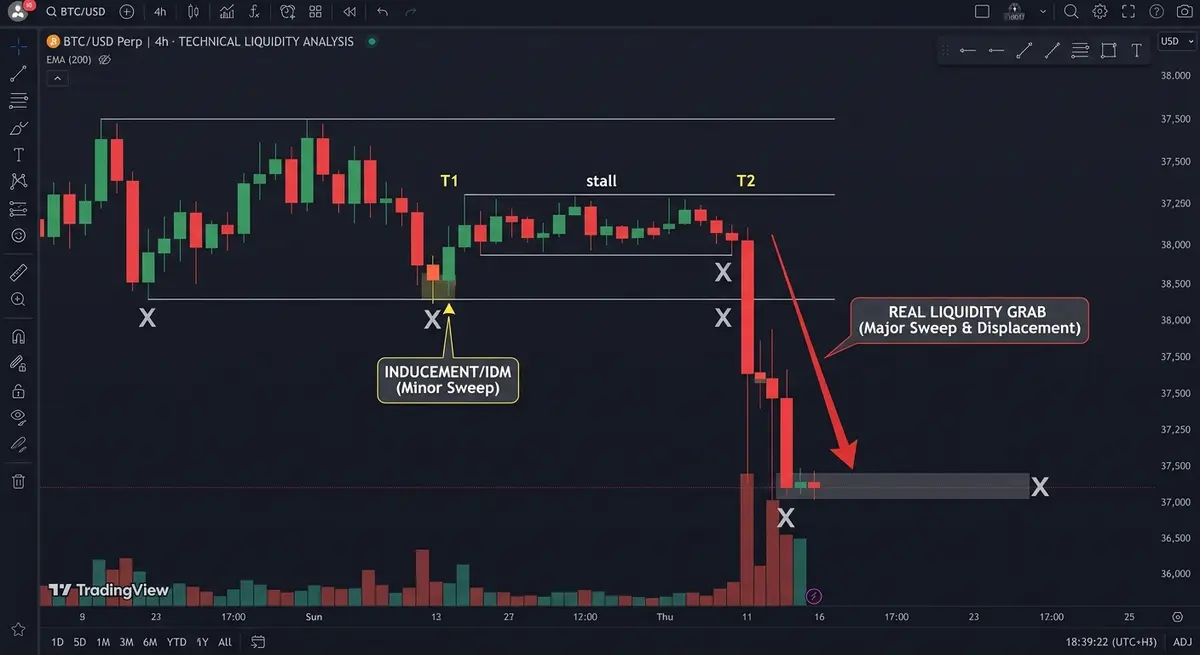
Inducement, often shortened to IDM, refers to a deliberate-looking move that draws in retail orders and stops at a specific, identifiable location before the market's actual intended move. It typically forms as a minor high or low just inside the range that's easy to spot and easy to trade against, precisely because it's meant to be noticed. The liquidity resting behind that minor level — stops from traders fading it, orders from traders breaking out on it — becomes the fuel for the next leg, not the destination of the current one.
What a Genuine Liquidity Grab Is: A Sweep With Displacement
A genuine liquidity grab targets buyside or sellside liquidity (BSL/SSL) resting at a more significant structural level — often the high or low that defines the current range or a prior swing point that a large number of participants would reasonably have stops behind. The defining mechanical feature that separates it from inducement is what happens immediately after the sweep: a genuine grab is followed by displacement away from the level, typically confirming a change of character (CHoCH) or break of structure (BOS) in the new direction. Inducement, by contrast, tends to produce a reaction that stalls or continues in the original direction rather than displacing away from it.
The Mechanical Sequence: Why Inducement Comes First
Inducement and liquidity grabs aren't two competing possibilities that occur randomly — they tend to occur in a specific order within the same move. The market typically sweeps a minor, obvious level first (the inducement), uses the liquidity generated by that sweep to fund a continued push toward the level that actually matters, and only then produces the genuine grab with displacement at that more significant level. Reading the first sweep as the main event skips over the fact that the sequence usually isn't finished yet.
This sequencing is what makes the concept of internal range liquidity (IRL) versus external range liquidity (ERL) useful here. The inducement sweep typically clears out internal liquidity — stops sitting inside the current range, generated by the minor level's own recent formation. The genuine grab, by contrast, is usually aimed at external liquidity — a pool sitting beyond the range extremes, built up over a longer period and representing a larger, more consequential accumulation of resting orders. The market has a structural reason to visit the smaller pool first: it's closer, it's cheaper to reach, and clearing it adds fuel for the larger move toward the pool that actually matters.
Why Retail Traders Enter on the Inducement, Not the Grab
The inducement level is, by design, the more visually obvious one — it's often a cleaner, more recent, easier-to-mark high or low than the more significant structural level the real move is actually headed toward. Retail traders scanning for "a sweep followed by a reaction" will find the inducement first simply because it's more prominent on the chart, and a brief stall or minor reversal after that sweep is enough to look like confirmation, even though the underlying liquidity dynamics haven't actually reset yet.
Why Neither Signal Alone Is Enough Without Confirmation
Even correctly identifying which sweep is the inducement and which is the genuine grab isn't sufficient without waiting for the confirming displacement. A sweep at a significant level that doesn't produce a decisive displacement move away from it afterward hasn't yet demonstrated it was the real grab rather than a larger, still-not-final instance of inducement. The confirmation — displacement plus a structural break — is what turns a sweep from a candidate into a confirmed signal; without it, you're still just watching liquidity get taken with no evidence yet of which direction the real move is headed.
It's worth being explicit that this isn't a call to wait indefinitely for perfect certainty before acting. It's a call to require one specific, checkable piece of evidence — displacement following the sweep — that's absent from a raw sweep on its own. That single condition is the difference between reacting to a sweep because a sweep occurred, and reacting to a sweep because it's already shown the behavior that separates it from bait.
The Bridge: How Liquidity Grab Engine Solves This
Distinguishing a genuine grab from inducement in real time requires tracking the relative significance of the level being swept, watching for displacement in the seconds and minutes immediately after the sweep, and holding off on a directional read until that confirmation actually shows up — three things that are easy to skip under the pressure of watching a sweep happen live.
Liquidity Grab Engine is built to keep that sequence explicit rather than leaving the inducement-versus-grab judgment to a fast, in-the-moment read:
- Relative liquidity pool sizing — sweeps are evaluated against the significance of the level being taken, so a minor, inducement-style level isn't visually flagged with the same weight as a major structural high or low.
- Post-sweep displacement confirmation — a sweep is only tagged as a confirmed liquidity grab once genuine displacement away from the level actually occurs, rather than the moment the sweep itself happens.
- Sequential sweep tracking — flagging when a sweep occurs shortly after a prior, smaller sweep in the same session, surfacing the possibility that the first was inducement funding the second.
- Multi-timeframe liquidity pool mapping — showing which pools are significant on a higher timeframe versus which are minor, lower-timeframe levels more likely to function as inducement within a larger move.
This connects directly to a related, equally costly version of the same timing problem — entering on the setup that looks confirmed but isn't — covered in the real reason your stop loss gets hit one tick before reversal: stops placed just behind an inducement-style level are exactly the liquidity the next leg is often built to take.
Execution: How to Read the Indicator on Your Chart
- Check the relative significance tag on a sweep before treating it as the real move. A sweep flagged as minor or inducement-style shouldn't be traded the same way as one flagged against a major structural pool.
- Wait for the displacement confirmation flag before entering in the reversal direction. A sweep without confirmed displacement afterward hasn't yet demonstrated it was the genuine grab rather than a setup for a further move.
- Review the sequential sweep flag when two sweeps occur close together in the same session. If a smaller sweep preceded a larger one, treat the first as probable inducement rather than a standalone signal.
Frequently Asked Questions
How can I tell inducement apart from a real liquidity grab in real time? The clearest tell is what happens immediately after the sweep — a genuine grab is followed by displacement and a structural break in the new direction, while inducement tends to stall or continue rather than reverse decisively. Waiting for that confirmation, rather than reacting the moment a sweep occurs, is the single highest-value adjustment for this specific mistake.
Does inducement always happen before every liquidity grab? Not in every single instance, but it's common enough in ranging and early-session conditions that it should be checked for by default rather than assumed absent. A sweep at a minor level shortly before a larger one is a strong candidate for this sequence even when it isn't guaranteed.
Why does the market bother creating inducement instead of just moving directly to the real liquidity pool? Moving directly to a major pool without first generating the liquidity from a smaller sweep would require the larger move to be funded entirely by existing order flow, without the added liquidity a minor sweep generates from stops and breakout entries. The inducement sweep isn't decorative — it contributes real liquidity that helps fund the larger move that follows it.
Ready to Stop Trading the Bait?
The first sweep you see isn't always the one that matters — confirmation, not speed, is what separates a real entry from an inducement trap.
Ready to implement this institutional logic? Deploy the Liquidity Grab Engine indicator on your charts now.