
Inversion Fair Value Gaps Explained: The Setup Most Retail Traders Miss
Introduction: The Gap That "Failed" Wasn't Actually Finished
You mark a bullish Fair Value Gap. Price returns to it, doesn't hold, and closes straight through it. By every standard definition, the setup failed — so you delete the zone and move on. Days later, price returns to that exact same level from the other side, and reacts there as resistance, in the opposite direction of what the gap originally implied.
This isn't the market being contradictory. It's a mechanical consequence you discarded too early. When a Fair Value Gap is fully violated — not just touched, but closed through with conviction — it doesn't stop mattering. It inverts. The zone that once represented unfilled buying interest becomes evidence of unfilled selling interest, and vice versa. This post explains exactly why that inversion happens, how it differs from a gap that simply invalidates and disappears, and why most retail tracking of Fair Value Gaps misses this setup entirely because it only watches for confirmation, not failure.
The Core Logic: Why a Failed Gap Becomes a New Signal
What "Inversion" Actually Requires
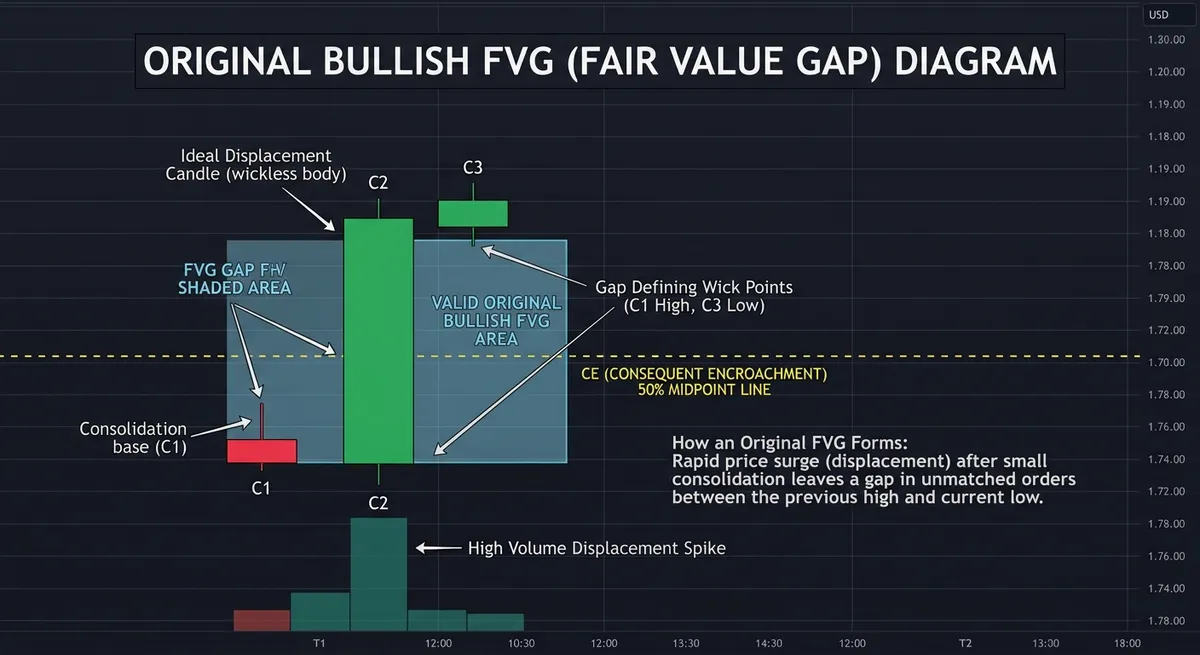
A standard bullish Fair Value Gap represents a zone of unfilled buy-side interest, formed by a fast upward move that left a three-candle imbalance behind it. The expectation is that price eventually returns to this zone and reacts upward, absorbing the remaining resting orders.
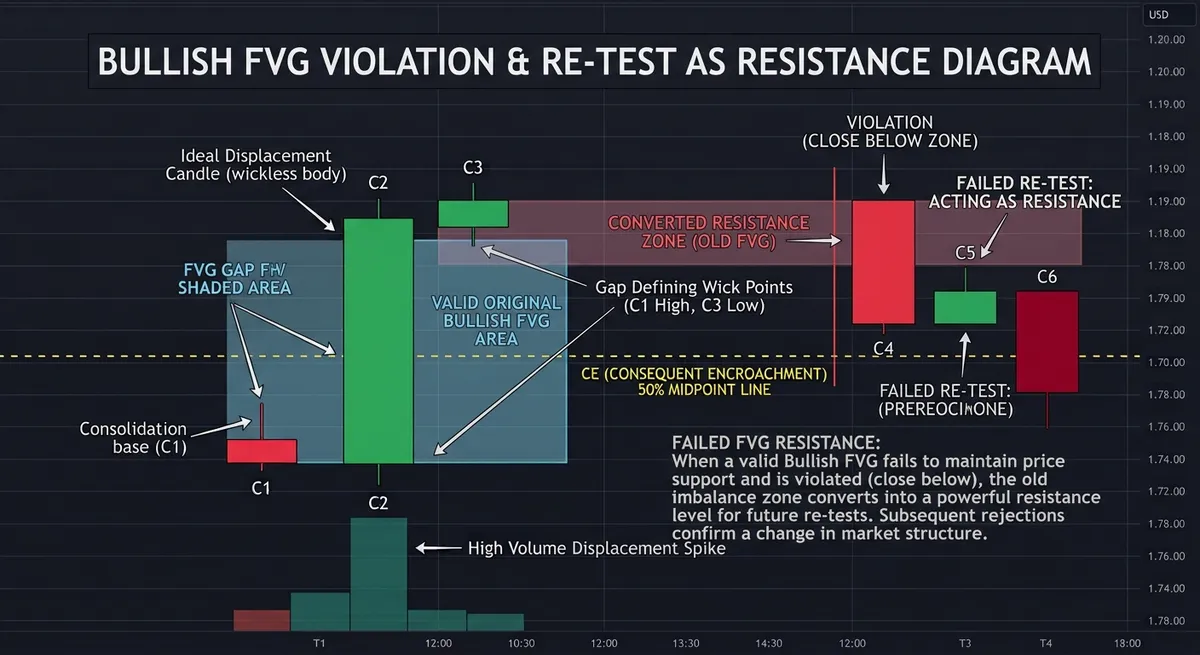
An Inversion Fair Value Gap (IFVG) forms when that expectation fails outright — price doesn't just tag the gap, it closes a full candle body through the entire zone, violating it completely rather than reacting inside it. This distinction matters: a wick that dips into the gap and recovers is not an inversion, it's simply price interacting with the zone as originally expected, even if imperfectly. Inversion requires full violation, confirmed by a candle close beyond the far boundary of the gap, not just a touch.
Why Failure Carries Information
A Fair Value Gap represents an assumption: that the resting interest behind the original imbalance is still strong enough to defend that price zone on a return visit. When price closes straight through it instead, that assumption has been falsified by real order flow — the opposing side absorbed and overwhelmed the resting interest that was supposed to hold.
This is the key mechanical insight: the zone doesn't lose relevance when this happens, it changes ownership. The same price range that failed to hold as support (in a bullish gap) has just demonstrated, through actual traded volume, that sellers are now in control at that level. On a retest from below, the same zone that once represented unfilled buy orders now represents a level where sellers have already proven willing to defend. This is structurally identical to the "breaker" concept applied to order blocks — a failed zone doesn't vanish, it flips role.
Distinguishing Inversion from Simple Invalidation
Not every violated Fair Value Gap becomes a usable IFVG. The distinction is about what happens immediately after the violation, not the violation itself:
- Simple invalidation — price closes through the gap and continues on with no meaningful reaction at the boundary, no displacement away from it, and no clean retest afterward. This is a gap that failed and stayed failed — there's no new signal to extract.
- Genuine inversion — price closes through the gap, and the close itself is followed by displacement in the new direction, effectively treating the old zone as an origin point for a fresh move. The zone is now a candidate for a retest from the opposite side, at which point it can act as resistance (from a failed bullish gap) or support (from a failed bearish gap).
The difference is not academic — trading every violated FVG as an automatic inversion setup ignores the fact that most violations are simply invalidations with no structural follow-through behind them.
Why This Requires Synthesis, Not a Single Rule
Identifying a genuine IFVG isn't a single-condition check. It requires confirming the original gap existed and was tracked, confirming a full-body close beyond it (not a wick), confirming displacement in the new direction immediately following that close, and — for the setup to carry weight — confirming that the resulting zone aligns with the higher-timeframe bias rather than fighting it. A trader who reacts to the violation alone, without waiting for confirming displacement, is trading a coin flip: some violations are genuine inversions, and a large share are simple invalidations that continue with no reaction at all. This is precisely why single-signal reactions underperform multi-condition synthesis in this specific setup.
Why Retail Tracking Misses This Entirely
Most manual and even automated Fair Value Gap tracking is built around two states: fresh and mitigated. A gap that gets fully violated is typically just marked mitigated or removed from the chart, exactly like a gap that reacted cleanly and held. This binary tracking throws away the distinction that matters most for this setup — a mitigated-by-holding gap and a mitigated-by-failing gap are not the same event, and only the second one is a candidate for inversion. If your tracking method deletes a gap the moment it's violated, you've structurally excluded yourself from ever seeing this setup form.
The Bridge: How the FVG Indicator Tracks This Instead of Discarding It
Tracking Inversion Fair Value Gaps by hand requires doing something most manual approaches actively avoid — continuing to watch a zone after it has failed, waiting to see whether the violation produces confirming displacement, and then re-classifying the same price range as a new type of zone with an inverted directional bias. This is a continuous-state-tracking problem, not a one-time pattern read, which is exactly the kind of task that degrades under manual, attention-limited monitoring.
Why this specific concept benefits from a rules-based tool rather than discretion: the setup only exists because most traders stop watching a zone the moment it fails. A tool that treats "violated" as a terminal state makes the same mistake at scale. Correctly surfacing IFVGs requires the tool to keep every violated gap in an active tracking state, check for confirming displacement after the violation, and only then reclassify it — which is a workflow, not a single visual pattern.
This connects directly to the mechanics of why a Fair Value Gap gets revisited in the first place, covered in why price keeps filling the fair value gap and reversing — that post explains the standard fill-and-react behavior; inversion is what happens when that expected reaction fails outright instead.
The FVG Indicator handles this by:
- Continuing to track violated gaps rather than deleting them once price closes through, keeping the zone active for inversion evaluation instead of treating a full violation as the end of its relevance.
- Confirming full-body closes, not wicks, before flagging a violation — filtering out the wick-based false reads that don't represent genuine failure.
- Checking for displacement after the violation before reclassifying the zone as an active IFVG, so a simple invalidation with no follow-through isn't presented with equal weight to a genuine inversion.
- Marking the inverted zone with its new directional bias, so a former bullish gap now flagged as resistance (or the reverse) is visually distinct from an untouched, fresh gap.
Execution: How to Read the Indicator on Your Chart
- Check for the inversion flag before assuming a violated gap is irrelevant. If the indicator has reclassified a failed gap as an active IFVG, that zone still matters — just with the opposite directional bias from its original formation.
- Confirm displacement occurred before treating the inversion as valid. A gap the tool marks as violated but not yet confirmed as an inversion (no follow-through displacement flagged) should be treated as a simple invalidation, not a tradeable setup.
- Cross-check the inverted zone against higher-timeframe bias before entering a retest. An IFVG that aligns with the dominant higher-timeframe direction carries more weight than one formed against it — use the multi-timeframe context rather than trading the inversion in isolation.
Frequently Asked Questions
What is an Inversion Fair Value Gap in trading?
An Inversion Fair Value Gap is a Fair Value Gap that has been fully violated by a candle closing through its entire range, after which it flips role — a failed bullish gap can act as resistance on a later retest from below, and a failed bearish gap can act as support on a retest from above.
How is an IFVG different from a regular mitigated Fair Value Gap?
A regular mitigated gap has been touched and reacted to as originally expected — it held. An Inversion Fair Value Gap has failed outright, with price closing fully through it, and only becomes tradeable again if that failure is followed by confirming displacement in the new direction rather than continuing with no reaction at all.
Are Inversion Fair Value Gaps reliable on their own as an entry signal?
No single condition — the violation alone — is sufficient. A genuine inversion requires a full-body close beyond the gap, confirming displacement afterward, and ideally alignment with the higher-timeframe bias; trading every violated gap as an automatic inversion ignores that a large share of violations are simple invalidations with no structural follow-through.
Ready to Stop Deleting Your Failed Setups?
A Fair Value Gap that fails hasn't stopped being useful — it's changed what it's telling you, and that information disappears the moment you treat "violated" as "irrelevant."
Ready to implement this institutional logic? Deploy the FVG Indicator on your charts now.