
Stop Overtrading: Why the Best Crypto Scalpers Take Only 2-3 Setups a Session
Introduction: The Chart Never Stops Offering You Something
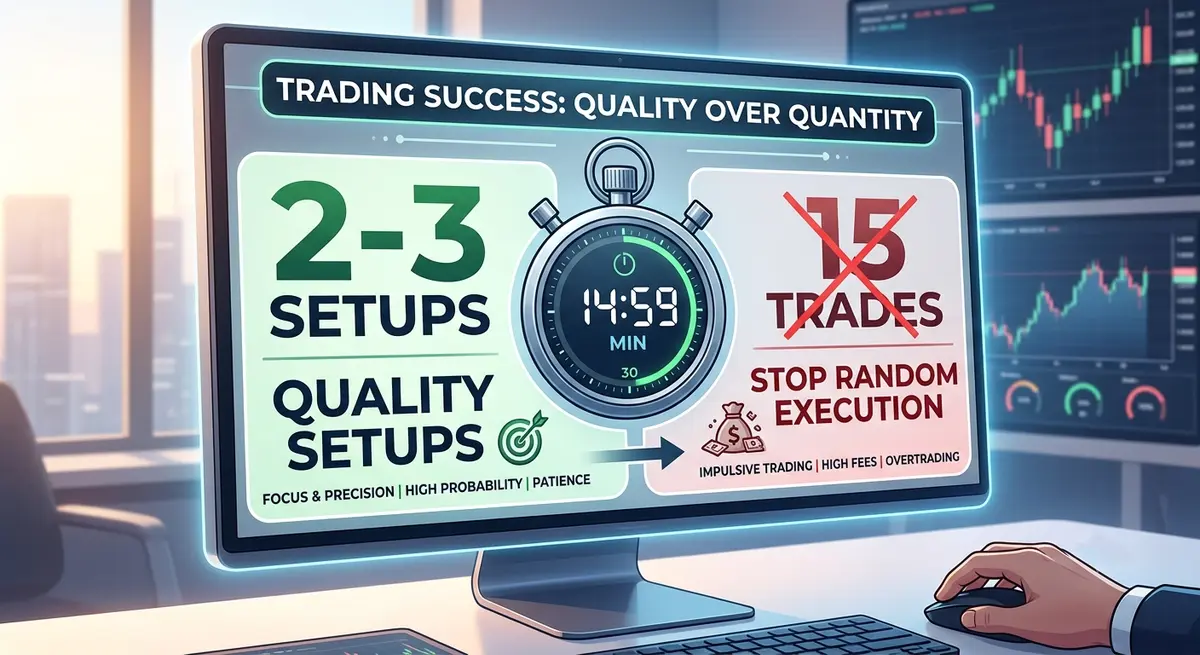
Watch a 1-minute chart long enough and every candle starts to look like an opportunity. A small push here, a rejection wick there, a brief squeeze that resembles the last winning trade — the chart never actually goes quiet, and neither does the impulse to act on what it's showing you. By the end of a session you've taken fifteen trades instead of three, and the account reflects the difference between a curated read and a reactive one.
This isn't a discipline failure in the moral sense retail trading content usually frames it as. It's a structural fact about how noisy price action looks on a compressed timeframe: the smaller the timeframe, the higher the ratio of meaningless fluctuation to genuine, tradeable structure. A profitable scalper isn't someone with faster reflexes or better willpower — they're someone applying a filter strict enough that most of what the 1-minute chart offers gets correctly ignored.
Framed this way, the fifteen-trades session and the three-trade session aren't really different levels of the same skill — they're two different filters applied to the same raw material. The chart offered the same amount of visual noise either way. The difference is entirely in how much of that noise got mistaken for signal before an order was placed.
This post covers why virtually every candle on a fast timeframe can be made to look like a setup, what actually separates a genuine high-probability scalp from noise that happens to resemble one, and why the number of trades that clear a real filter tends to land at two or three a session rather than fifteen.
The Core Logic: Why the Chart Always Looks Busy
Why Every 1-Minute Candle Looks Like a Setup
Human pattern recognition doesn't discriminate well between meaningful structure and coincidental resemblance, especially under the mild stress and boredom that comes from watching a chart continuously. A brief pullback that superficially resembles a prior winning entry will trigger the same recognition response whether or not the underlying conditions that made the prior trade work are actually present. On a 1-minute chart, this happens constantly, because the sheer number of candles gives pattern-matching far more raw material to work with than it would get on a slower timeframe.
Signal vs Noise: What Separates a Genuine Scalp From a Random Wiggle
The mechanical difference between a real setup and noise that resembles one comes down to confluence — whether multiple independent structural conditions align at the same moment, rather than a single visual pattern appearing in isolation. A genuine scalp typically requires a liquidity sweep, a confirmed displacement move, and alignment with the higher-timeframe bias all showing up together. A random wiggle can produce any one of those in isolation fairly often; producing all three at the same time, in the same direction, is a meaningfully rarer event — which is exactly why it should be a rarer trade.
Confluence Requirements That Naturally Limit Setup Count
The reason disciplined scalpers land near two or three trades a session isn't an arbitrary limit they've imposed on themselves — it's the natural output of requiring genuine confluence rather than a single condition. If a setup requires three or four independent factors to align simultaneously, the number of times that alignment actually occurs in a session is inherently small. A trader taking ten or fifteen scalps a session is, almost by definition, trading on a lower confluence bar than one taking two or three, whether or not they'd describe their own criteria that way.
This is worth stating plainly because it reframes the entire question of "how many trades should I take." It isn't a target to hit or a discipline goal in the way it's often presented — it's a downstream consequence of the actual filter being applied. Deciding in advance to cap trades at three a session, without tightening the underlying confluence requirement, just delays the same overtrading problem to whichever three signals happen to trigger first, rather than fixing the filter that determines whether any given signal deserved to be acted on in the first place.
Why More Trades Doesn't Mean More Opportunity — It Means More Correlated Risk
Extra trades taken beyond the small number that clear a genuine confluence bar aren't independent additional opportunities; they're lower-quality variations of the same market condition, often correlated with each other and with the trades already taken. Three genuinely independent, confluence-backed setups in a session represent three separate readable conditions. Fifteen trades taken across the same session are mostly repeated exposure to the same underlying volatility regime, dressed up as separate decisions because each one had a slightly different entry price.
This matters for risk in a way that isn't obvious from looking at position size alone. A trader who sizes each of fifteen trades as if it were an independent bet is, in practice, running far more concentrated exposure to a single market condition than the position sizing implies, because a meaningful share of those trades will win or lose together rather than independently. The account-level risk of an overtraded session is understated by any risk calculation that treats each trade as statistically separate from the others.
Why Overtrading Compounds the Fee Problem
Every additional trade beyond a genuine setup isn't a neutral extra attempt — it's a trade that, by construction, has a lower edge than the setups that actually cleared the confluence bar, while still paying the exact same round-trip fee as a high-conviction trade. This is the same fee mechanism covered elsewhere on this site: fees are a fixed cost per trade regardless of quality, so a marginal, low-confluence trade is disproportionately more likely to be a net loser purely because it's carrying the same fee cost against a smaller and less reliable edge.
The two problems reinforce each other in a way that makes overtrading worse than the simple sum of its parts. A session with three high-conviction trades pays fees three times against a genuinely favorable edge each time. A session with fifteen trades pays fees fifteen times, and the twelve extra trades beyond the confirmed setups are, on average, the lowest-edge trades of the session — meaning the fee drag is concentrated precisely on the trades least equipped to absorb it.
The Bridge: How High-Frequency Scalper Solves This
Manually enforcing a strict confluence requirement, trade after trade, in real time, on a fast-moving chart, is exactly the kind of discipline that erodes the longer a session runs — fatigue and the sheer volume of visual noise on a 1-minute chart make it progressively harder to hold the same bar for setup number twelve that you held for setup number one.
High-Frequency Scalper applies the confluence filter mechanically rather than relying on in-the-moment judgment:
- Confluence-based signal filtering — a setup only triggers when liquidity sweep, confirmed displacement, and higher-timeframe alignment are all present simultaneously, rather than flagging any single condition on its own.
- High-conviction vs marginal signal tagging — setups that clear every confluence condition are visually distinguished from weaker, partial matches, so a marginal wiggle doesn't get mistaken for a full setup.
- Session setup tracking — the indicator surfaces how many genuine, fully-confirmed setups have fired in the current session, making it visible when trade count is running well above what the filter itself has actually confirmed.
- Post-trade cooldown logic — flagging a brief window after a signal fires during which subsequent, closely correlated signals are treated as continuations of the same condition rather than new independent opportunities.
This connects directly to the cost side of the same problem: every marginal trade taken outside the confirmed signal set is also a trade paying full fees against reduced edge, which is the mechanism covered in the fee math that quietly kills most crypto scalpers — overtrading and fee drag compound each other rather than acting as separate issues.
Execution: How to Read the Indicator on Your Chart
- Only act on signals tagged high-conviction, not marginal matches. A marginal tag means at least one confluence condition didn't fully confirm — treat it as a pass, not a smaller version of a real setup.
- Check the session setup counter before adding another trade. If you've already taken the number of confirmed setups the tool has flagged for the session, additional trades are, by definition, not clearing the same bar as the ones already taken.
- Respect the post-trade cooldown window before re-entering in the same direction. A signal firing again inside that window is more likely a continuation of the same condition than a genuinely new, independent opportunity.
Frequently Asked Questions
Is taking only 2-3 trades a session actually enough to be profitable? It can be, because profitability depends on the quality and edge of each trade relative to its cost, not on trade count. A small number of high-confluence trades with a real edge can outperform a much larger number of marginal trades that individually have less edge and collectively pay far more in fees.
How do I know if I'm overtrading versus just seeing more legitimate setups than usual? Check whether each trade independently cleared every confluence condition your strategy requires, rather than judging by how the session felt. A session with genuinely more independent setups than usual is possible, but it should show up as more fully-confirmed signals, not more trades taken on partial matches.
Doesn't limiting trade count mean missing out on profitable opportunities? Not if the trades being skipped were never going to clear a genuine confluence bar in the first place — those aren't missed opportunities, they're avoided low-edge trades. The opportunities worth taking are, by definition, the ones the filter confirms.
Ready to Trade Less and Keep More?
The traders scalping profitably aren't watching the chart harder than everyone else — they're requiring more from it before they act.
Ready to implement this institutional logic? Deploy the High-Frequency Scalper indicator on your charts now.